
Comparing Apple’s 2026 Watches: How Series 11, SE 3 and Ultra 3 Differ
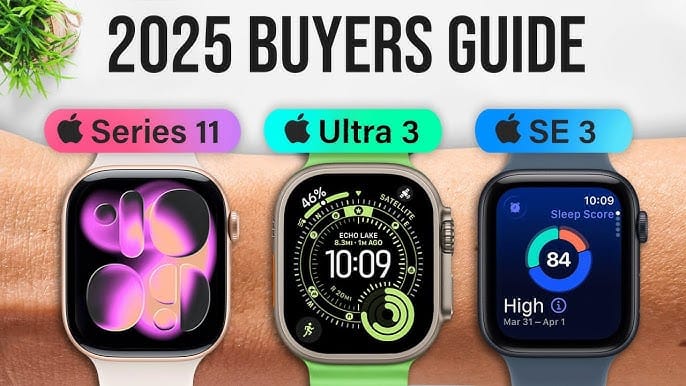
Apple introduced three new Apple Watch models this year: the Apple Watch Series 11, Apple Watch SE 3 and Apple Watch Ultra 3. The Ultra 3 sits at a premium price point intended for a niche market and athletes, while most consumers will decide between the more affordable SE 3 and the mid‑range Series 11.
Price positioning is clear. The Apple Watch SE 3 starts at $249, the Series 11 begins at $399, and the Ultra 3 is priced at $799. Beyond cost, the decision hinges on which features matter most: core health and smartwatch capabilities, advanced health monitoring and battery performance, or rugged, athlete‑focused hardware.
Despite its lower price, the SE 3 carries much of the same software experience as the Series 11. That makes it an appealing choice for first‑time buyers, younger users, and anyone seeking a straightforward smartwatch with essential features such as step counting and sleep tracking.
Both the Series 11 and SE 3 share a long list of capabilities that narrow the gap between Apple’s standard and budget smartwatches. Core similarities include their processor, display behavior, safety features and a range of health and convenience functions.
- S10 chip: Both models use the S10 chip, which aligns their performance characteristics.
- Always‑on Retina display: Each watch can show the watch face and time while the wrist is down.
- Heart and health notifications: High and low heart rate alerts, irregular rhythm notifications and low cardio fitness notifications are available on both devices.
- Gestures: Wrist flick and double‑tap gestures are supported to dismiss notifications, answer calls or control media.
- Emergency features: Emergency SOS, fall detection and crash detection can call local emergency services, share location and notify emergency contacts.
- Water resistance and swim use: Both watches are water resistant to 50 meters.
- Sleep tracking and temperature sensing: Each device supports sleep tracking, sleep score reporting and nightly wrist temperature monitoring, which also supports retrospective ovulation estimates for cycle tracking.
- Fast charging: Both watches are fast‑charge capable. The Series 11 reaches up to 80% charge in about 30 minutes and the SE 3 in about 45 minutes. Either model can provide around eight hours of normal use after a 15‑minute charge.
- Find iPhone integration: Both can play a sound on a paired iPhone; Series 11 adds precision finding to pinpoint the phone’s location.
There are also clear distinctions that may sway buyers toward one model over the other. Battery life, advanced health sensors, display performance, size and materials differ between the Series 11 and the SE 3.
- Battery life: The Series 11 offers up to 24 hours of typical use and up to 28 hours in low‑power mode. The SE 3 provides up to 18 hours of typical use and up to 32 hours in low‑power mode.
- Advanced health features: The Series 11 includes additional monitoring and detection features — hypertension notifications (for high blood pressure), an electrical heat sensor, an ECG app and a Blood Oxygen app — that are not present on the SE 3.
- Screen and brightness: The Series 11 can reach up to 2,000 nits brightness and uses a wide‑angle OLED. The SE 3 reaches up to 1,000 nits and uses a simple OLED panel.
- Sizes and materials: Series 11 is available in 46mm and 44mm sizes with aluminum or titanium cases and is nearly 10% thinner than the SE 3. The SE 3 is available in 44mm and 40mm sizes with an aluminum case.
- Color and build differences: Series 11 aluminum finishes include Jet Black, Silver, Rose Gold and Space Gray; titanium options are Natural, Gold and Slate. The SE 3 is offered in Midnight Aluminum and Starlight Aluminum.
- Other hardware: The Series 11 adds a depth gauge to six meters, a water temperature sensor, a lower minimum brightness of 1 nit (versus 2 nits on the SE 3) and certified IP6X dust resistance.
For consumers deciding between the two mainstream models, the SE 3 delivers substantial value. It includes the S10 chip, an always‑on display, improved durability and a broader set of health and convenience features compared with its predecessor. Those upgrades make it a strong option for users who want robust functionality without paying for premium sensors or materials.
The Series 11 targets buyers who want more advanced health monitoring, a brighter and larger display, longer daily battery life and additional sensors and durability features. It is also the choice for customers who prefer titanium case options or the slightly thinner chassis.
The Ultra 3, at its $799 price point, is positioned for a smaller audience: athletes and users who need the most rugged hardware and specialized features. For the majority of shoppers, the decision will come down to whether the Series 11’s enhanced health and display capabilities justify its higher price compared with the SE 3’s strong value proposition.
Ultimately, the gap between Apple’s standard and budget smartwatches has narrowed. Buyers should weigh priorities — health monitoring, battery life, screen performance and case materials — when choosing between the Series 11 and the SE 3, and consider the Ultra 3 only if premium ruggedized features and athlete‑focused tools are required.
Key Topics
Apple Watch Series 11, Apple Watch Se 3, Apple Watch Ultra 3, Series 11 Vs Se 3 Comparison, Apple Watch Price Guide, S10 Chip Performance, Always-on Retina Display, Battery Life And Low-power Mode, Advanced Health Monitoring, Ecg And Blood Oxygen Apps, Water Resistance And Swim Tracking, Rugged Smartwatch For Athletes, Fast Charging And 15-minute Boost