
Dosage-sensitive genes indicate no separate whole-genome duplication at origin of flowering plants
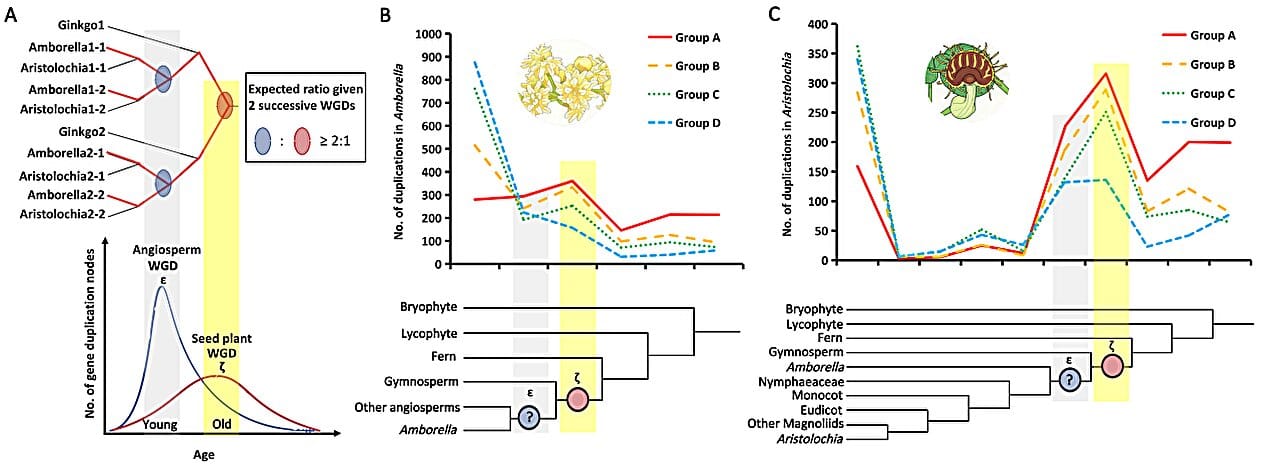
Flowering plants (angiosperms) are the most diverse seed plants, and whole-genome duplications (WGDs) have long been proposed as key drivers of their origin and evolution. Detecting ancient WGDs is difficult because subsequent gene loss, chromosomal rearrangements and substitution saturation can obscure genomic signals.
Earlier work proposed two early WGDs: ζ at the base of seed plants and ε at the base of angiosperms. A later study questioned the ε signal, suggesting it could be an artifact of molecular dating inconsistencies. Researchers from the Wuhan Botanical Garden of the Chinese Academy of Sciences and Ghent University used dosage-sensitive genes as markers to revisit these ancient WGD hypotheses, reporting their results in Science Advances.
The team classified orthologous gene groups into four categories (A–D) by how closely observed copy numbers matched expected post-WGD counts. Highly dosage-sensitive groups (Group A) showed stronger purifying selection, more protein–protein interactions, broader tissue expression and clear Ks peaks for known WGDs, validating their use as WGD indicators.
Using gene tree–species tree reconciliation, gene copy number correlation and probabilistic retention modelling, and focusing on two early-diverging angiosperms that lack later WGDs, the researchers tested competing scenarios for ancient duplications.
Key Topics
Science, Angiosperms, Seed Plants, Whole-genome Duplication, Dosage-sensitive Genes, Amborella Trichopoda