
Eruption at Mayon sends lava and pyroclastic flows
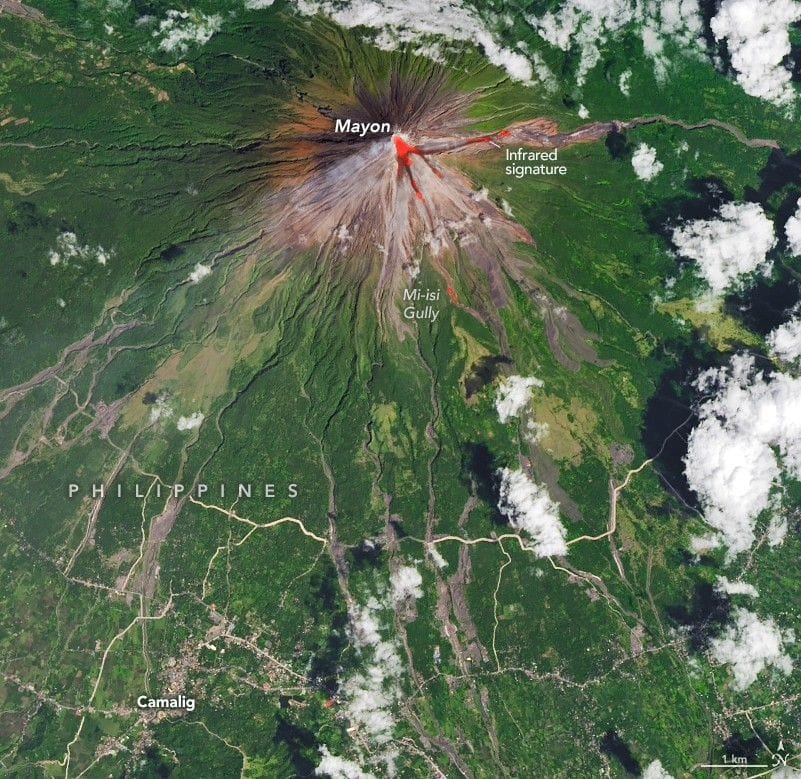
Mayon, the Philippines’ most active volcano, has been erupting since January 2026. The nearly symmetrical stratovolcano on Luzon rises more than 2,400 meters above sea level and has produced 65 eruptions over the past 5,000 years. Early in January, the Philippine Institute of Volcanology and Seismology noted increased rockfalls and inflation of the upper slopes, and on January 6 the alert level was raised to three after lava began flowing from the crater and pyroclastic flows moved down one side of the mountain.
On February 26, the Operational Land Imager on Landsat 8 captured a relatively clear natural-color image overlaid with infrared to highlight the lava’s heat. That day authorities reported volcanic earthquakes, rockfalls, and pyroclastic flows; the longest flow traveled about 4 kilometers through the Mi-isi Gully on the southeast flank.
Philippines, Luzon
mayon, volcano, philippines, luzon, eruption, lava, pyroclastic flows, stratovolcano, landsat 8, mi-isi gully