Gaia parallax reveals Saturn‑mass rogue planet in the so‑called Einstein desert

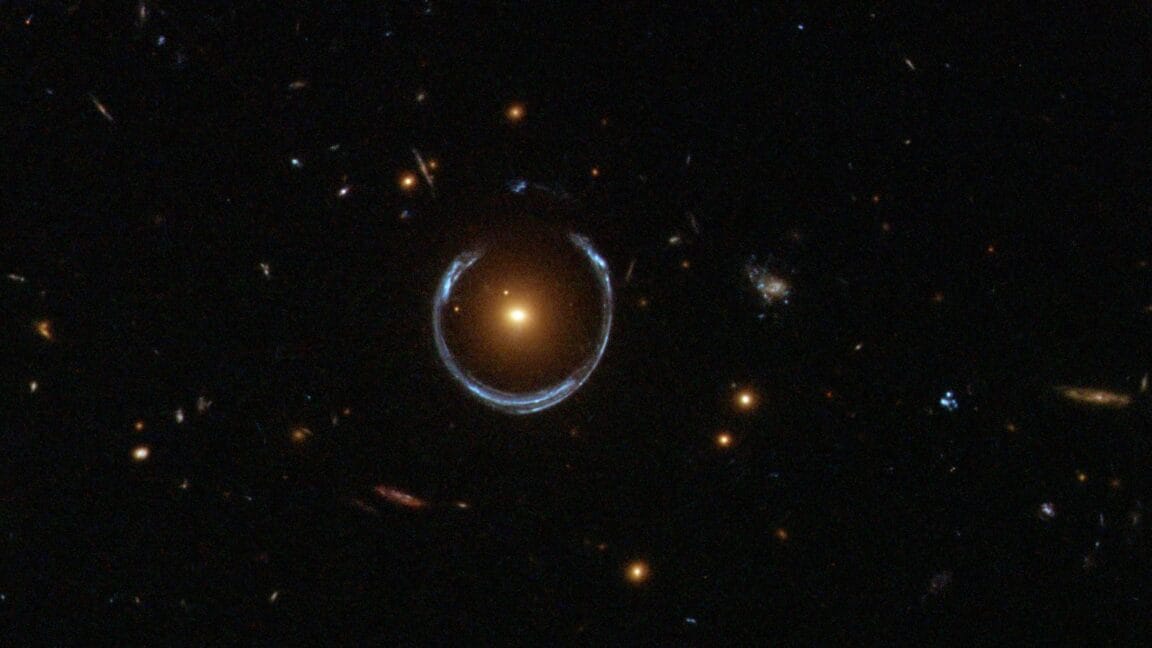
Researchers used a microlensing event observed from Earth and by the Gaia space telescope to identify a Saturn‑sized rogue planet in the middle of the so‑called "Einstein desert." The microlensing event was recorded by the Korea Microlensing Telescope Network (KMT-2024-BLG-0792) and the Optical Gravitational Lensing Experiment (OGLE-2024-BLG-0516) in early May 2024.
Gaia, positioned at the L2 point, happened to observe the event six times over 16 hours. Its different vantage point produced a roughly two‑hour delay in the brightness peak relative to Earth, allowing a parallax measurement and an estimate of the event distance. Pre‑ and post‑event images identify the background source as a red giant in the Galactic bulge, which helped constrain the star's size and distance.
Combining that information with the Einstein‑ring measurement yielded a planet mass of about 0.2 Jupiter masses — slightly smaller than Saturn. That mass places the lens squarely in the middle of the Einstein desert, a gap seen in the distribution of Einstein‑ring sizes from microlensing surveys.
This is the first microlensing detection reported in that gap. Scientists see two possible origins for rogue planets: ejection from planetary systems, which should favor smaller bodies, and direct collapse like star formation that runs out of gas, which would produce much larger gas giants or brown‑dwarf‑scale objects.
Key Topics
Microlensing, Rogue Planet, Einstein Desert, Gaia Space Telescope, Kmt-2024-blg-0792, Ogle-2024-blg-0516