
Gray Limestone Pavement Shapes Ireland’s Burren
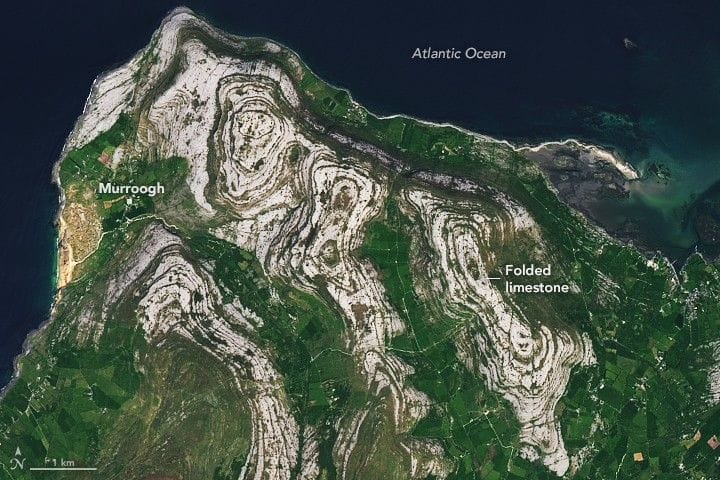
Landsat imagery reveals a stretch of gray amid Ireland’s many greens: the Burren on the island’s west coast, where fossil-rich limestone forms a rocky, treeless terrain known as limestone pavement. That limestone was deposited about 325 million years ago in warm, shallow seas during the Carboniferous Period, when Ireland lay near the equator.
Tectonic collision during the Variscan Orogeny later buckled the layers into gentle folds, and differential erosion left terrace-like ledges; glacial action then scraped away soil and exposed the pavement. Chemical weathering has produced karst features—sinkholes, caves, and fissures called grikes.
Many grikes collect soil and support plants, creating the concentric vegetation patterns visible from space. Among the plants found there are shamrock-like clovers such as Trifolium dubium and Trifolium repens; an 1880s survey referenced by the Carnegie Museum of Natural History shows those species were favored by Irish botanists as shamrock candidates.
Ireland, Burren
burren, limestone pavement, ireland, landsat imagery, carboniferous, variscan orogeny, karst features, grikes, trifolium dubium, trifolium repens