
Hubble and Euclid Reveal the Cat’s Eye Nebula
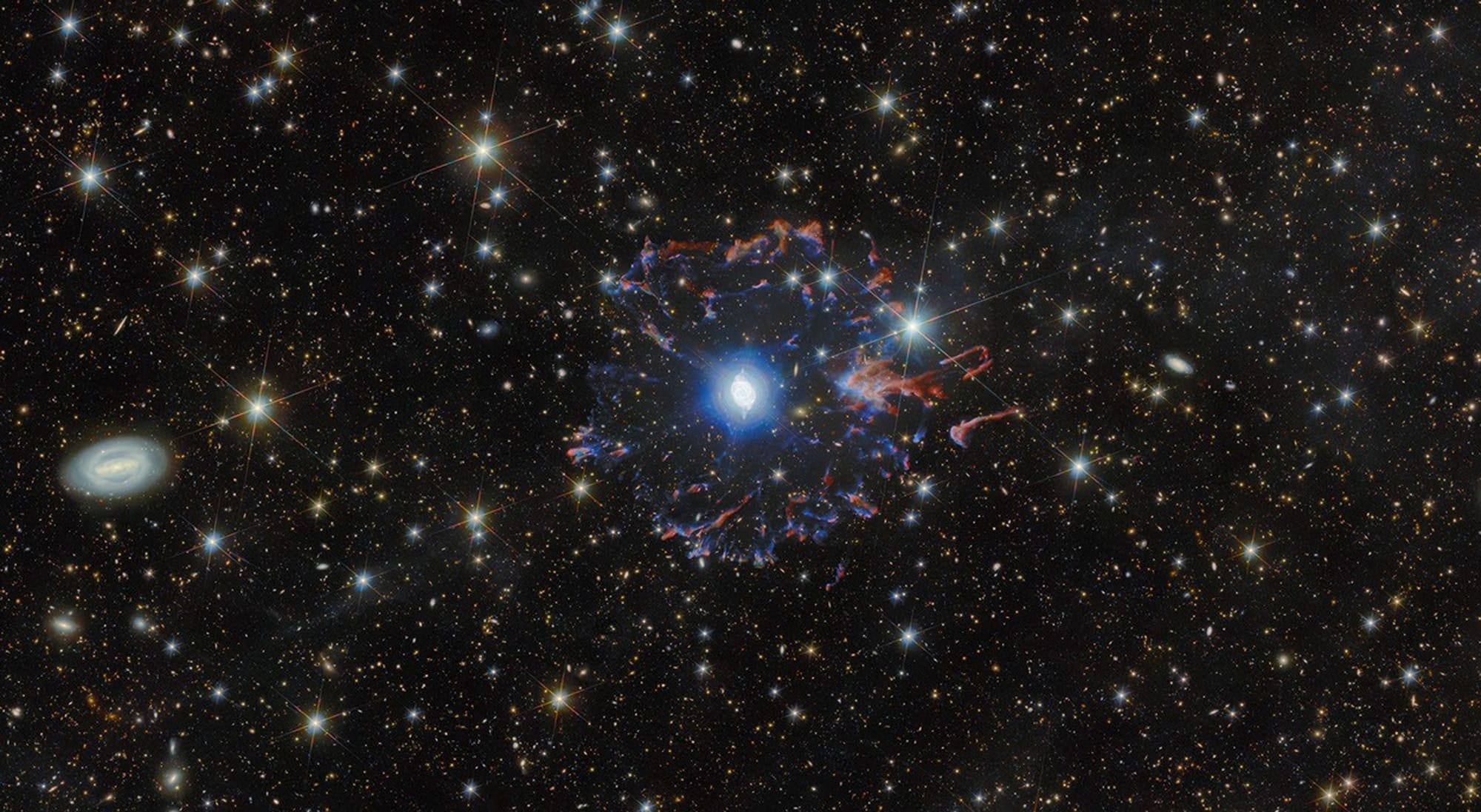
Hubble and ESA’s Euclid have combined views of one of the most intricate planetary nebulae, the Cat’s Eye Nebula (NGC 6543), located in the constellation Draco at about 4,400 light-years as measured by Gaia. Planetary nebulae are expanding gas thrown off by stars in their final stages, and the Cat’s Eye was key to that discovery in 1864 when its spectrum showed emission from individual molecules.
Hubble’s detailed imaging—most famously in 1995—revealed that a seemingly round nebula can conceal a very complex morphology. Euclid’s wide, near-infrared and visible-light view places the bright central arcs and filaments inside a halo of colorful gas fragments, and shows an outer ring ejected earlier than the main nebula; the scene sits against a backdrop crowded with distant galaxies.
Hubble’s high-resolution visible-light image adds focus to the core, exposing concentric shells, jets of high-speed gas and dense knots sculpted by shock interactions.
hubble, euclid, gaia, cat's eye, ngc 6543, planetary nebulae, draco, near infrared, visible light, concentric shells