
Hubble Captures Gas Plume Stripped from Spiral Galaxy in Virgo Cluster
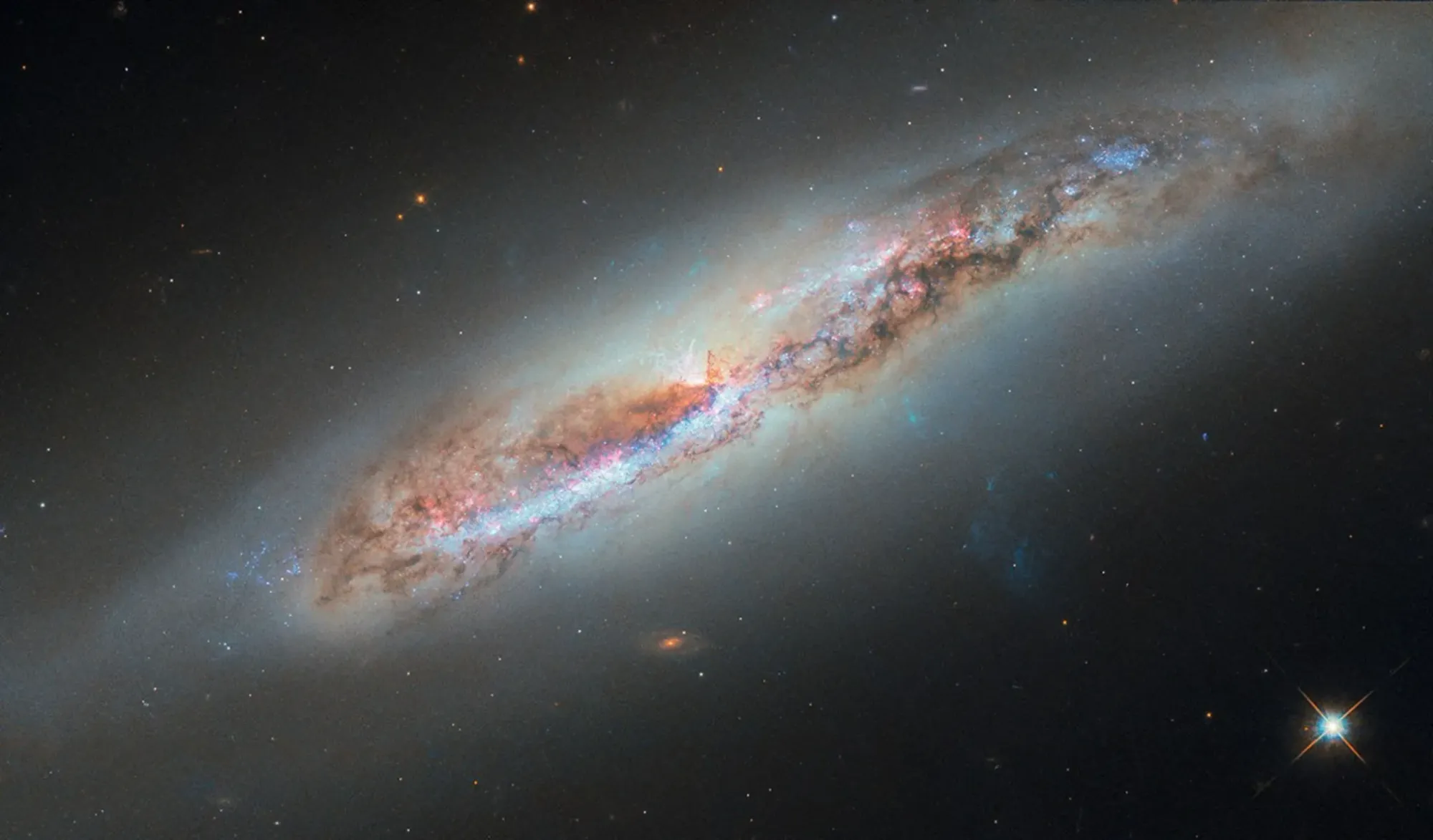
A new Hubble Space Telescope image shows the spiral galaxy NGC 4388, located about 60 million light-years away in the constellation Virgo, and a resident of the Virgo galaxy cluster.
Seen nearly edge-on from Earth, the galaxy reveals a previously unseen plume of gas streaming from its nucleus and billowing out from the disk toward the lower-right of the image.
A likely cause is the intracluster medium — hot gas that pervades the space between galaxies in the Virgo cluster. As NGC 4388 moves through this medium, pressure from the hot gas strips material from the galaxy’s disk, leaving trailing gas behind.
The source of the ionizing energy that makes the gas glow is less certain. Researchers suspect some ionization comes from the galaxy’s center, where a supermassive black hole powers a superheated accretion disk whose radiation can ionize nearby gas, while shock waves may ionize more distant filaments.
This image combines new data, including several additional wavelengths of light, to bring the ionized gas cloud into view. The observations are part of programs aimed at illuminating galaxies with active central black holes.
The image and article were published Jan. 02, 2026 by the NASA Hubble Mission Team at Goddard Space Flight Center. Author: Monika Luabeya.
Image credit: ESA/Hubble & NASA, S. Veilleux, J. Wang, J. Greene
Key Topics
Science, Virgo Cluster, Hubble Space Telescope, Intracluster Medium, Supermassive Black Hole, Nasa