
Hubble Reveals Gas Plume Escaping Spiral Galaxy NGC 4388
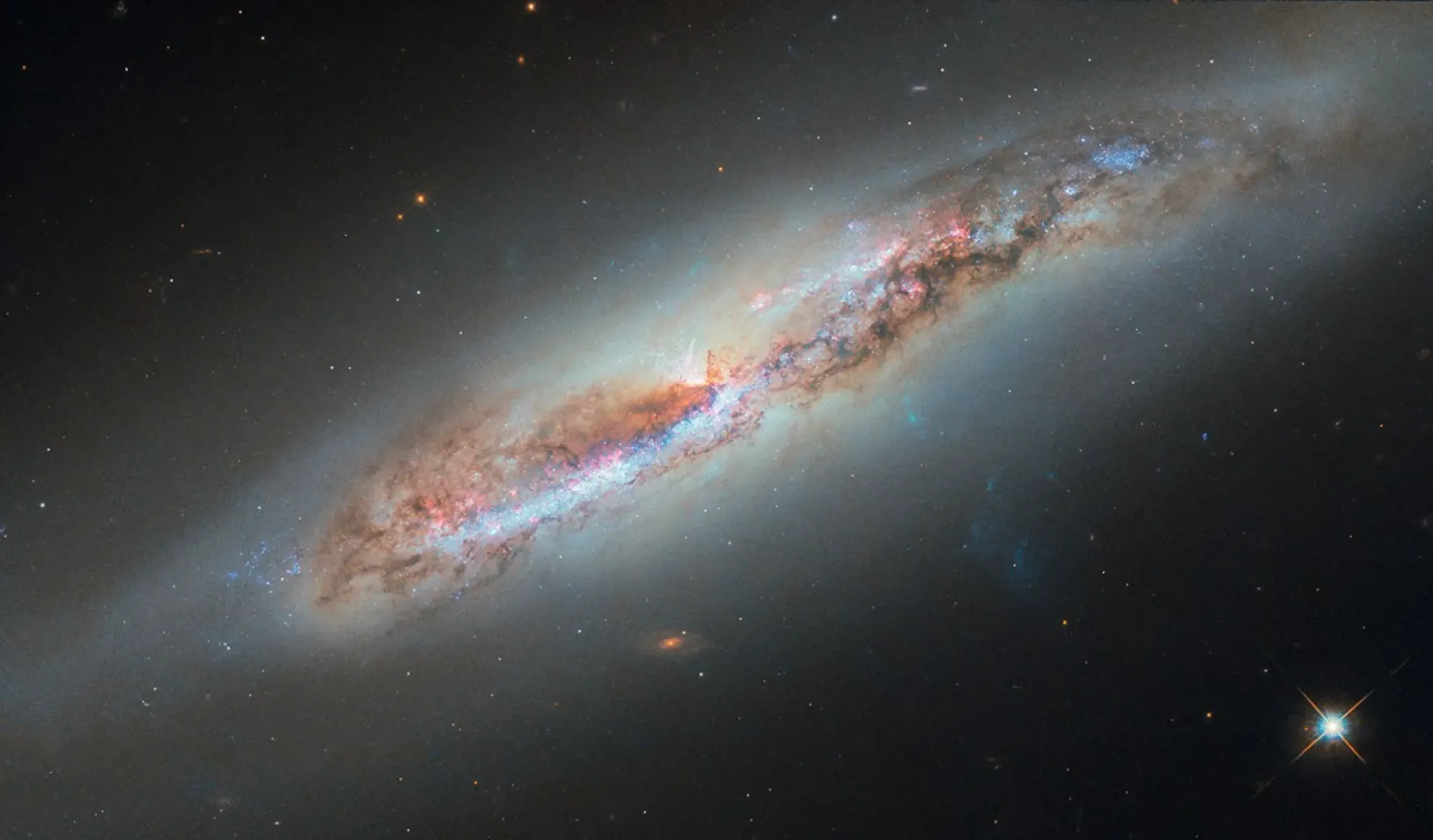
A new NASA/ESA Hubble Space Telescope image shows the spiral galaxy NGC 4388 from nearly edge-on, revealing a plume of gas streaming from its nucleus. NGC 4388 lies about 60 million light-years away in the constellation Virgo and is a member of the nearby Virgo galaxy cluster, which contains more than a thousand galaxies.
The plume, visible in this updated Hubble view but not in a 2016 image, appears to billow out from the galaxy’s disk toward the lower right of the frame.
A likely cause is the galaxy’s motion through the hot intracluster medium that fills the space between galaxies in the Virgo cluster. Pressure from that medium can strip gas from a galaxy’s disk, leaving material trailing behind as the galaxy moves.
Researchers say the source of the ionizing energy that makes the gas glow is less certain. Some ionization may come from the galaxy’s center, where a supermassive black hole powers a hot accretion disk, while shock waves could ionize filaments farther from the nucleus.
The image combines new data at several wavelengths and draws on observing programs focused on galaxies with active central black holes.
Image credit: ESA/Hubble & NASA, S. Veilleux, J. Wang, J. Greene
Key Topics
Science, Hubble Space Telescope, Virgo Galaxy Cluster, Intracluster Medium, Supermassive Black Hole, Accretion Disk