
Greenhouse growth around Leamington has altered land cover and night skies
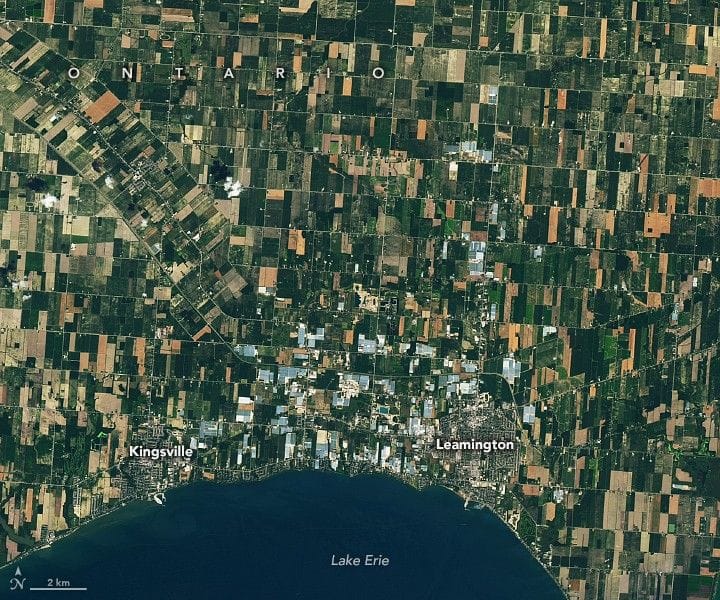
Satellite imagery shows the expansion of greenhouse operations around Leamington on the northern shore of Lake Erie is changing the appearance of the land surface and the night sky. Images acquired with the OLI (Operational Land Imager) on Landsat 8 compare the area in July 2015 and September 2025, showing many more light-colored greenhouse roofs by 2025.
According to the municipality, greenhouses occupy nearly 8 square kilometers (2,000 acres) in the Leamington area, the largest concentration in North America. Commercial greenhouse operations began to gain a foothold in the 1960s and 1970s as technology advanced and regional demand grew, and the facilities produce vegetables such as tomatoes, seedless cucumbers, and peppers, as well as other crops including strawberries and cannabis.
Supplemental LED lighting used to sustain year-round growing emits purple, orange, and yellow glows that have been spotted as far away as Windsor, Ontario, and Detroit, Michigan—about 50 kilometers (30 miles) away—according to news reports. Some ecologists have expressed concern about light pollution because Point Pelee, about 10 kilometers (6 miles) to the southeast, lies on migration routes for many birds and monarch butterflies and artificial light can affect their ability to navigate.
Recent measures have reportedly reduced light pollution. A town bylaw passed in 2022 requires greenhouses using lights to install light-blocking wall and ceiling curtains and to close them at night.
Key Topics
Science, Leamington, Point Pelee, Lake Erie, Greenhouse Agriculture, Light Pollution