
Mathematicians explore cutting an infinitely large pancake with exotic knives
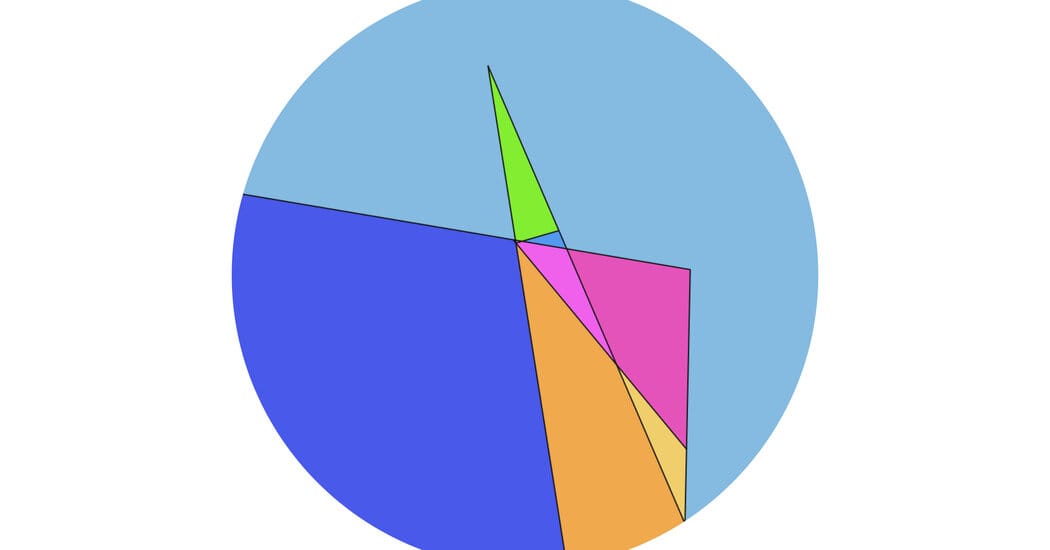
Two mathematicians, Neil J.A. Sloane and David O.H. Cutler, posted a paper online exploring how to cut an infinitely large pancake into as many pieces as possible, a new take on the Lazy Caterer’s problem. The work was debuted at an online experimental mathematics seminar run by Doron Zeilberger.
The researchers used a variety of strangely shaped knives — including a lollipop-style stem, a constrained capital A, a hatpin, V shapes, a three-armed “Wu,” and “nunchucks” — and relied on computer searches and hand sketches to find optimal configurations. Their program used an optimization routine and Euler’s formula, R−E+V=1, to count regions; Sloane is the founder of the On-Line Encyclopedia of Integer Sequences and Cutler is an undergraduate at Tufts, with Sloane a longtime visiting scholar at Rutgers.
The computer results produced many integer sequences: for the constrained A, zero through five knives gave 1, 3, 13, 30, 53, 83 pieces; a hatpin yielded 1, 1, 2, 4, 7, 11 for zero through five cuts; a V-shaped knife produced 2, 7, 16, 29…; and configurations of Wu, nunchucks and certain “long-legged” A’s all produced the same sequence (1, 3, 14, 34, 63, 101…), a triple coincidence that the authors turned into a theorem.
Key Topics
Science, Neil Sloane, David Cutler, Lazy Caterer's Problem, Integer Sequences, Doron Zeilberger