
NASA launches ESCAPADE twin orbiters to study how Mars lost its atmosphere
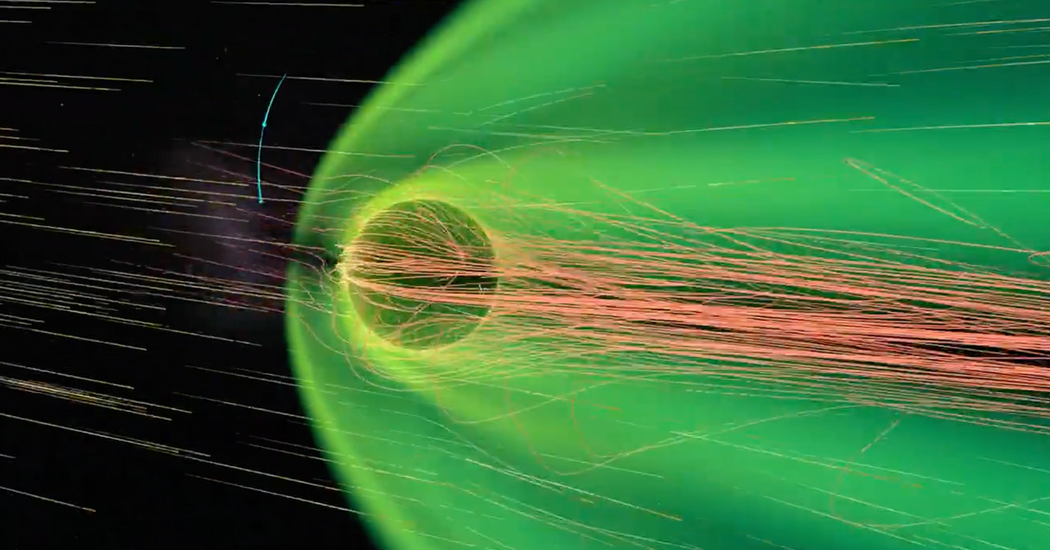
NASA’s ESCAPADE mission launched to space on Thursday aboard Blue Origin’s New Glenn rocket, sending two small twin orbiters bound for Mars. The pair, named Blue and Gold, are each about the size of a mini fridge and are designed to study how Mars went from having a thick atmosphere and flowing water to becoming cold, dry and nearly airless.
The spacecraft carry identical instruments: a magnetometer, an electrostatic analyzer to image charged particles, a probe to measure the temperature, density and voltage of charged particles, and a camera built by students at Northern Arizona University. ESCAPADE is the first mission to use multiple orbiters to make simultaneous measurements at different locations around Mars.
The plan calls for a yearlong science campaign beginning with the two spacecraft in a follow-the-leader elliptical orbit that will take them as close as about 100 miles and as far as about 4,300 miles from Mars, allowing observations of short-term changes in magnetic fields and the solar wind.
Six months later the orbiters will shift into different elliptical tracks so one can sample incoming solar wind while the other observes planetary magnetic responses, enabling study of longer-distance effects.
Key Topics
Science, Escapade, Mars, Blue Origin, New Glenn, Rocket Lab