
NASA’s Roman and Webb telescopes to combine wide surveys with deep infrared follow-up
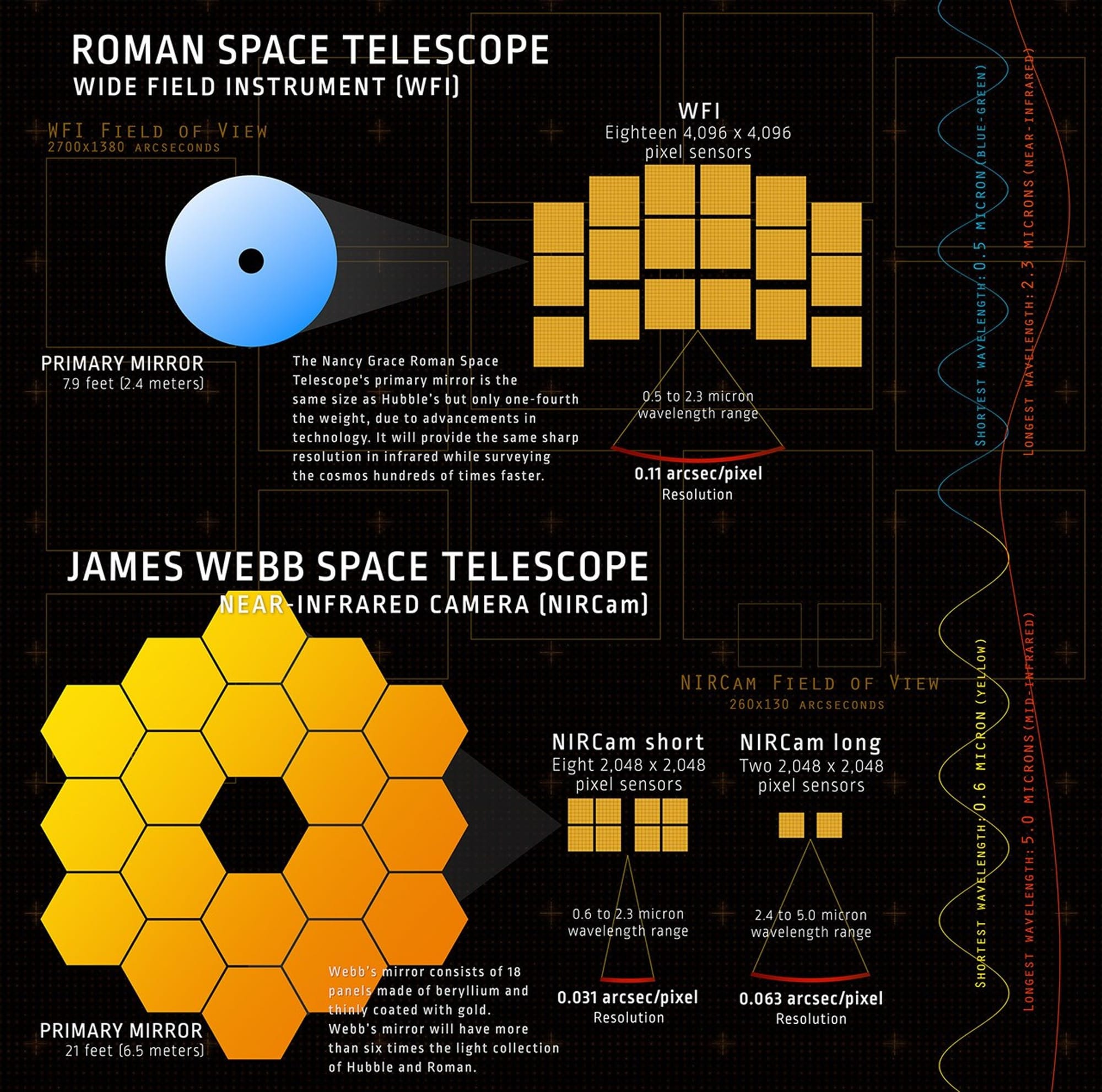
NASA’s Nancy Grace Roman Space Telescope and the James Webb Space Telescope will work in tandem to study the universe, with Roman conducting rapid, wide-area surveys and Webb providing narrower but more detailed infrared observations. Roman will capture giant, 300-megapixel images using 18 large detectors and a wide-field design, enabling surveys up to 1,000 times faster than the Hubble Space Telescope while maintaining Hubble-like resolution.
Roman’s panoramic view—images about 50 times larger than Webb’s—will reveal rare objects and transient events by observing regions repeatedly. Webb, with a larger primary mirror (21 feet / 6.5 meters versus Roman’s 7.9 feet / 2.4 meters), ultracold instruments, and powerful spectrographs, can see farther back in time and measure distant galaxies and exoplanets in greater detail.
Together the missions will address cosmology and structure: Roman will combine imaging and spectroscopy to map more than a billion galaxies and trace cosmic expansion using thousands of type Ia supernovae, while Webb can follow up those discoveries with detailed study. Roman will use weak gravitational lensing across a vast area to map dark matter distribution, and Webb has already revealed dark matter in distorted galaxies in its first science image.
Scientists say these complementary observations could help clarify dark energy and even prompt adjustments to current cosmological models.
Key Topics
Science, Roman Space Telescope, Webb Telescope, Dark Energy, Dark Matter, Gravitational Lensing