
Milky Way bulge cluster NGC 6569 is actively shedding stars, study finds
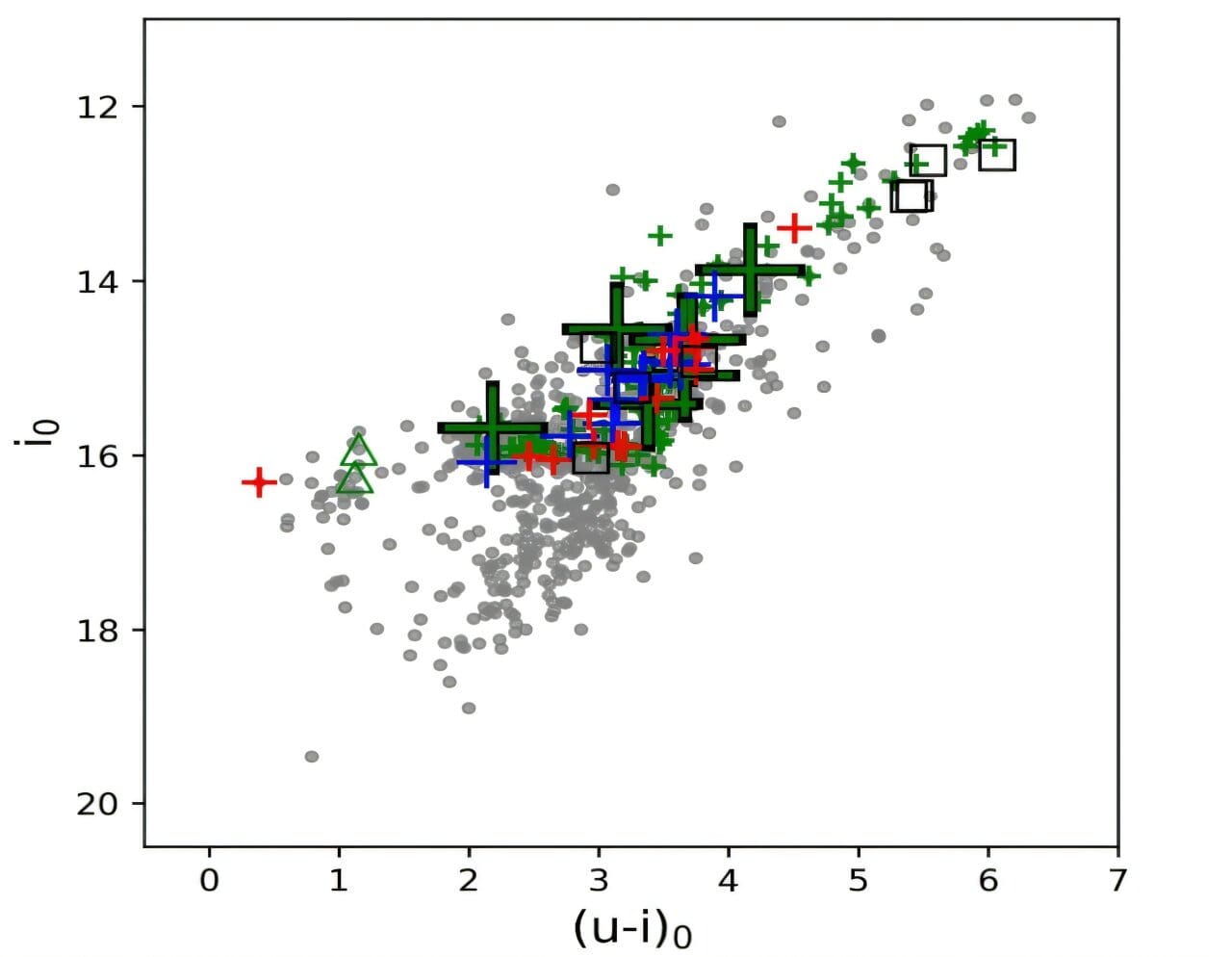
A team using the Anglo-Australian Telescope has found spectroscopic evidence that the globular cluster NGC 6569 in the Milky Way bulge is losing stars through tidal stripping. NGC 6569 lies about 35,500 light years from Earth, has a mass near 230,000 solar masses, a metallicity of roughly −0.8 dex and an estimated age of 13 billion years.
The observations were made as part of the Milky Way Bulge Extra-Tidal Star Survey (MWBest), led by Joanne Hughes. Models predict bulge clusters near the Galactic center can lose large fractions of their mass, but clear extra-tidal features are less often detected in bulge clusters than in halo clusters.
The AAT campaign obtained medium-resolution spectra of 303 stars. The authors identify 40 stars located about 7–30 arcminutes from the cluster center as bona fide tidal debris, and note five of those appear to form a halo of debris around the cluster. Comparing bound cluster stars with the surrounding field, the team finds roughly 35% of the local stellar population shares NGC 6569’s proper motion.
From chemo-dynamical constraints and dynamical analysis they estimate the cluster is undergoing mild, continuous stripping at about 5.6% of its mass per billion years, equivalent to roughly 1.0–1.6 solar masses lost per year at present. The authors suggest NGC 6569 may be moving through a tube of its own tidal debris, but say follow-up studies, including N-body simulations, are needed to confirm that picture.
Key Topics
Science, Milky Way, Anglo-australian Telescope, Joanne Hughes, Mwbest, Tidal Stripping