
Satellite animation shows algal blooms at Hartbeespoort reservoir
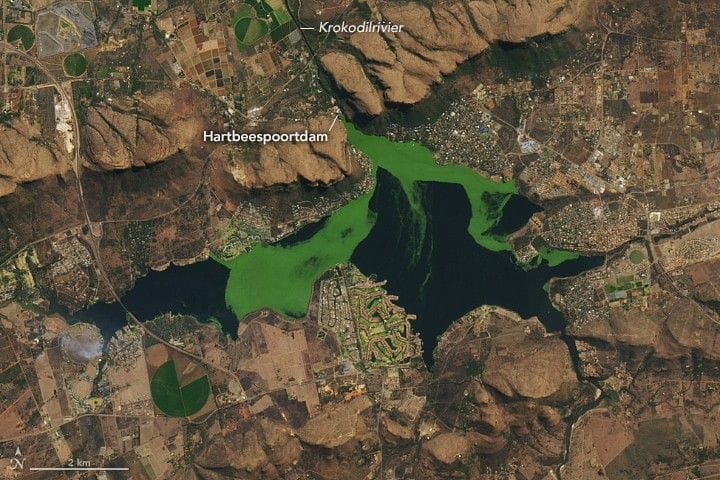
An animation of satellite images from June 2022 to July 2023 shows an algal bloom growing, moving and fading across the Hartbeespoort reservoir near Pretoria, South Africa. The animation uses the Harmonized Landsat and Sentinel-2 (HLS) product, which combines imagery from NASA/USGS Landsat 8 and 9 and ESA’s Sentinel-2A, 2B, and 2C satellites.
Algae range from single-celled cyanobacteria to seaweed and are important for ecosystems, but when they spread widely or release toxins they form harmful algal blooms (HABs). Eutrophication, driven by excess nutrients from agricultural runoff and other inputs, can spur rapid algal growth.
"It's like having a garden," said Bridget Seegers, a NASA scientist who studies cyanobacteria: "If you add a lot of nutrients, you’re going to have a lot of growth." As algae die and decompose, oxygen can be consumed, producing hypoxia and dead zones that have been documented at Hartbeespoort Dam.
The reservoir, used primarily for recreation and irrigation, regularly experiences HABs and hosts large mats of invasive water hyacinths, which can add to eutrophication when they decompose. In April 2023, South African authorities linked a large fish kill at Hartbeespoort to low oxygen levels caused by excessive algal growth.
Key Topics
Science, Hartbeespoort Dam, Hls Product, Cyanobacteria, Eutrophication