
Saturn-mass world found in the microlensing “Einstein desert”
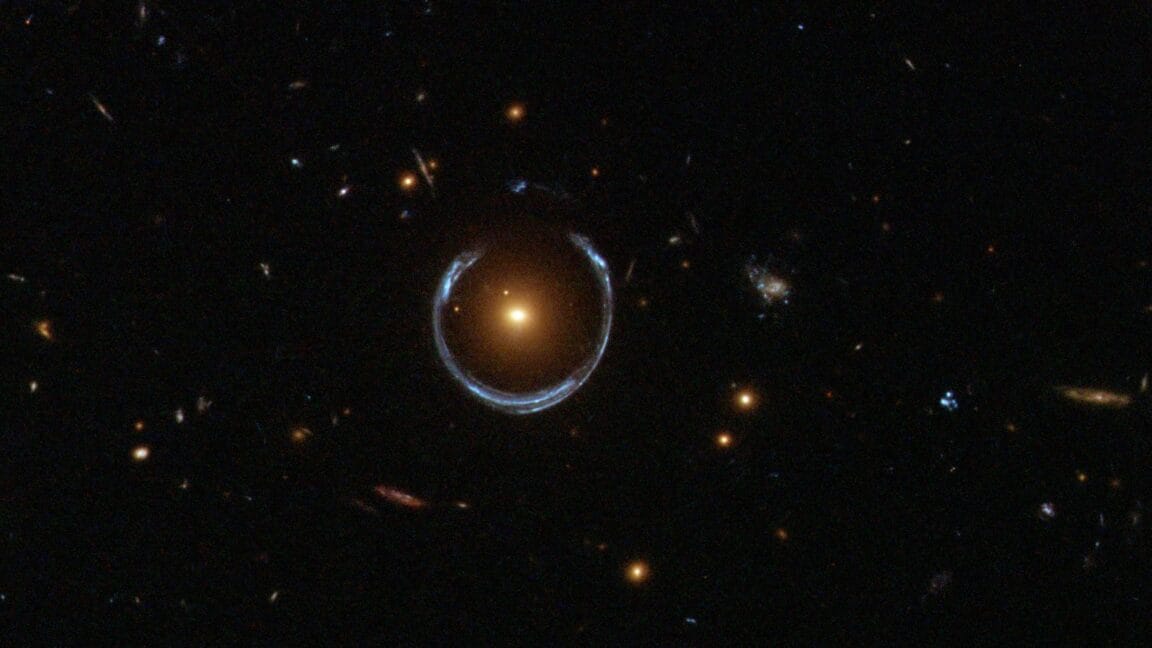
Researchers have used microlensing and a fortuitous Gaia observation to identify a roughly Saturn-mass planet in the so-called "Einstein desert," a gap in the distribution of microlensing event sizes.
The microlensing event, recorded in early May 2024 by both the Korea Microlensing Telescope Network (KMT) and the Optical Gravitational Lensing Experiment (OGLE), was observed from space by the European Space Agency's Gaia telescope six times over 16 hours. "Serendipitously, the KMT-2024-BLG-0792/OGLE-2024-BLG-0516 microlensing event was located nearly perpendicular to the direction of Gaia’s precession axis," the researchers write.
Gaia’s position at the L2 point produced a nearly two-hour delay in the event’s peak brightness compared with Earth-based telescopes. That time offset allowed scientists to measure the event’s parallax and estimate its distance.
Images before and after the event indicate the lensed star is a red giant in the galactic bulge. Combining the parallax with the size of the Einstein ring gave a planet mass of roughly 0.2 times Jupiter—described by the team as a bit smaller than Saturn—and placed the object in the middle of the Einstein desert. This is the first microlensing detection located there.
The finding feeds into two hypotheses for the origins of free-floating
Key Topics
Science, United States, Update, Update, Update