
Saturn-mass rogue planet spotted in the microlensing 'Einstein desert'
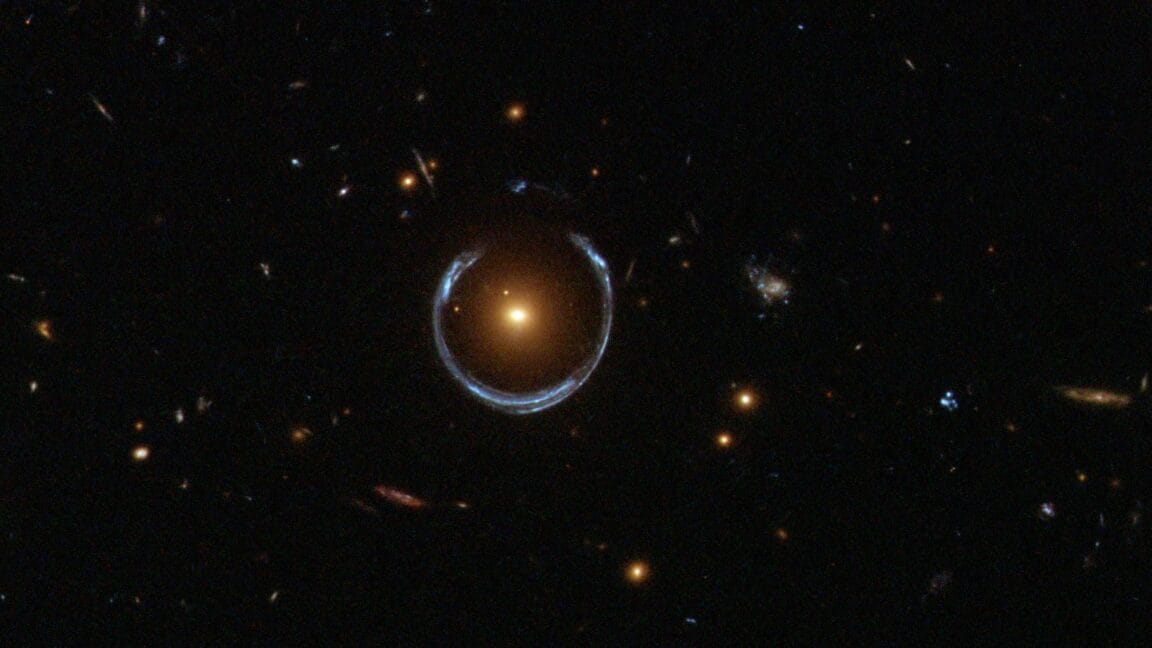
Researchers have used microlensing and images from the Gaia spacecraft to identify a free-floating, Saturn-sized planet in the region known as the "Einstein desert." The microlensing event, recorded by the Korea Microlensing Telescope Network as KMT-2024-BLG-0792 and by OGLE as OGLE-2024-BLG-0516, occurred in early May 2024.
Ground-based telescopes caught the event, and Gaia happened to observe it six times over a 16-hour span because of a favorable orientation. Gaia’s location at the L2 point meant the event’s peak appeared nearly two hours later than from Earth, enabling a parallax measurement. Combined with the size of the Einstein ring and archival images showing the source star to be a red giant in the galactic bulge, researchers estimated the lensing object’s mass at roughly 0.2 times Jupiter’s mass—slightly smaller than Saturn.
This is the first microlensing detection that falls squarely in the previously noted gap between clusters of small and large Einstein rings, the so-called Einstein desert. That placement helps tie the desert to a specific planetary mass and informs ideas about the origins of rogue planets.
Two formation pathways are discussed: ejection from planetary systems, which should bias toward lower-mass, rocky bodies, and direct collapse like star formation, which would produce objects closer to Jupiter mass or larger. A Saturn-mass object in the desert may sit near the upper limit of bodies typically ejected from systems.
Key Topics
Science, United States, Exoplanets, Microlensing, Gaia, Rogue Planets, Einstein Desert