
Shades of a Lunar Eclipse
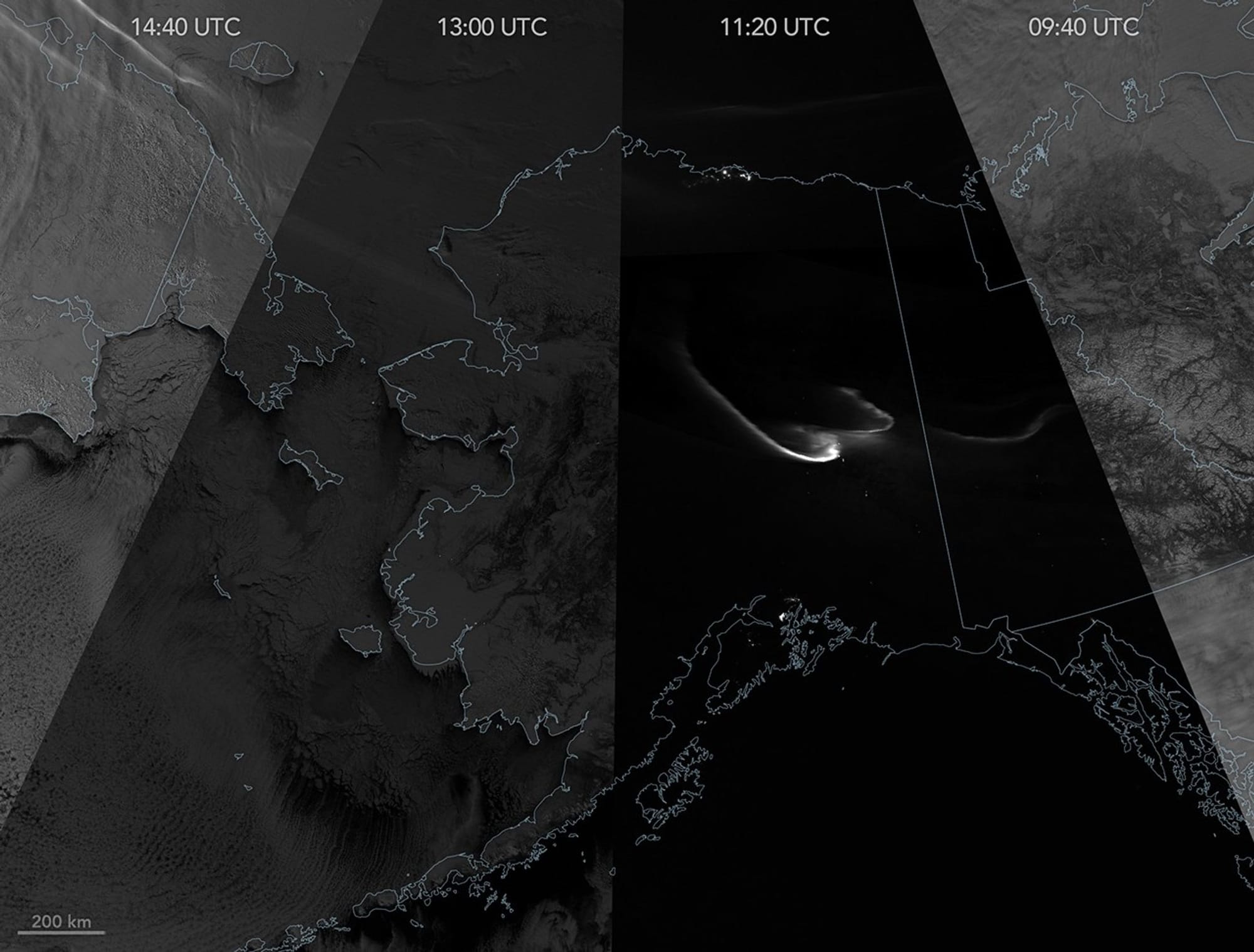
On March 3, 2026, Earth moved between the Moon and the Sun and cast its shadow across the full Moon. The total lunar eclipse was visible across the Americas, East Asia, Australia, and the Pacific, and many observers saw a dimmed lunar surface take on an orange-red “Blood Moon” hue.
A series of nighttime satellite images captured how moonlight reaching Earth changed during the event. The composite was made from observations by the VIIRS instrument on the NOAA-21 satellite, with swaths of the Arctic collected about every 100 minutes; earlier swaths appear on the right of the image and later swaths on the left.
The VIIRS day–night band senses light from green to near‑infrared and uses filtering to separate city lights, reflected moonlight, and auroras. The darkest swath was recorded at 11:20 Universal Time (2:20 a.m. Alaska Standard Time), roughly 15 minutes after the eclipse’s total phase began, when faint auroral ribbons and isolated settlement lights in the Yukon and eastern Alaska were most visible.
lunar eclipse, blood moon, moonlight, noaa-21, viirs, day-night band, satellite imagery, aurora, yukon, alaska