
Simulation says concrete runway wall caused all deaths in 2024 Jeju Air crash
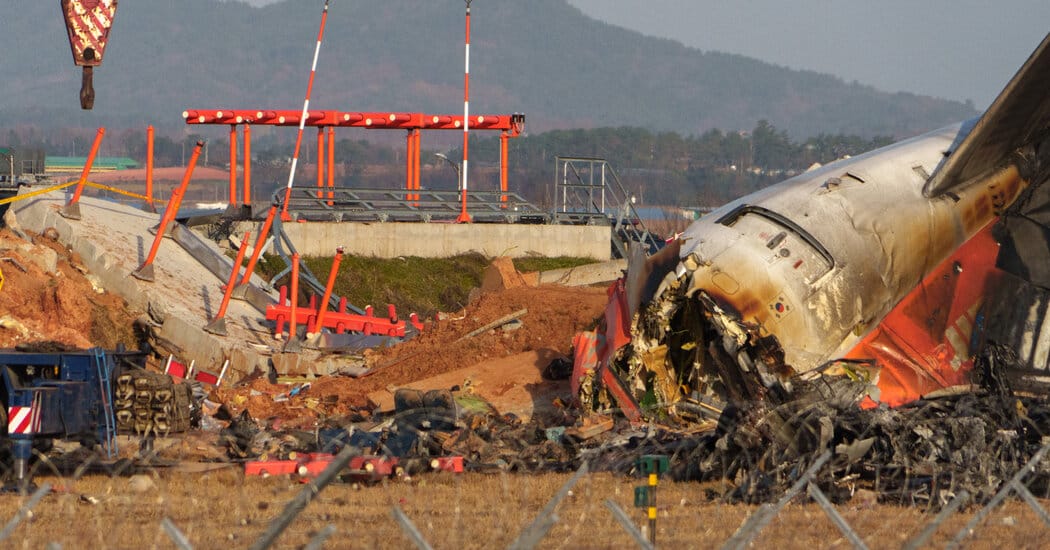
A previously undisclosed government-commissioned computer simulation concluded that everyone on board a Jeju Air flight that crashed at Muan International Airport in 2024 would have survived if a concrete berm at the end of the runway had been built with materials that break apart easily, the report obtained by The New York Times said.
The accident killed 179 people. The report, completed in August by the Computational Structural Engineering Institute of Korea for the Transport Ministry, modelled the Boeing 737-800’s belly landing. The analysis found the jet touched down without landing gear at 232 m.p.h., glided on its body for 3,800 feet and struck the concrete wall housing navigation localizers at about 161 m.p.h.
In an alternate scenario using frangible materials consistent with international guidelines, the plane would have passed through the localizers and perimeter wall, slid about 2,070 additional feet and come to rest largely intact with no severe injuries, the simulation said. A Times investigation also found the berm was designed in 1999, modified in 2003 and reinforced with more concrete 10 months before the crash, in ways that violated safety guidelines.
The broader investigation into why the plane crash-landed is still ongoing and has faced scrutiny from relatives and lawmakers.
Key Topics
World, Jeju Air, Muan International Airport, Transport Ministry, Concrete Berm, Runway Localizers