
Tiny Spacecraft Delivers Exoplanet Mission’s First Images
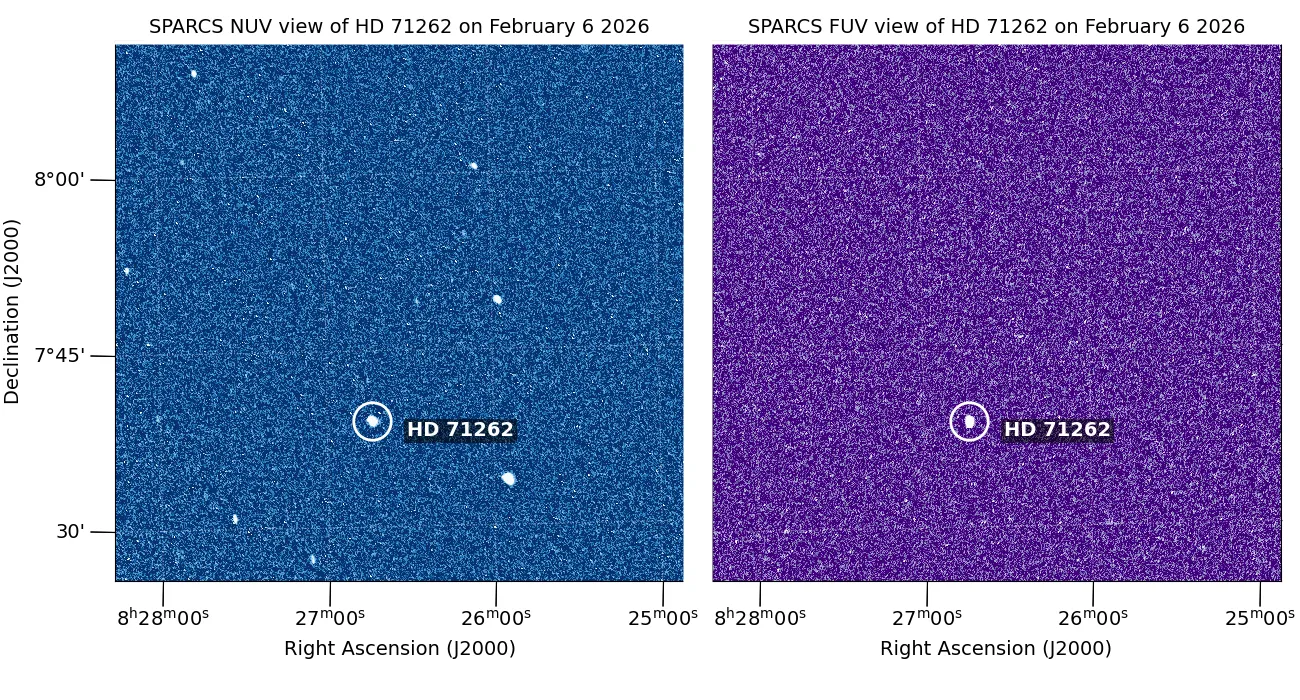
The Star-Planet Activity Research CubeSat (SPARCS) returned its first-light images on Feb. 6 after launching Jan. 11 and completing processing. Those initial images demonstrate the telescope and detectors are functioning in space and allow the team to move into full science operations focused on precise ultraviolet measurements.
About the size of a large cereal box, SPARCS will monitor flares and sunspot activity on low-mass stars — objects 30% to 70% the mass of the Sun — to help answer which distant worlds might be habitable. The spacecraft is the first dedicated to continuously and simultaneously observing far-ultraviolet and near-ultraviolet radiation from such stars, and over its one-year mission will target roughly 20 stars for periods of five to 45 days each.
The mission’s SPARCam uses specially developed delta-doped detectors with filters deposited directly onto the detector, eliminating a separate filter element and producing one of the most sensitive UV imaging systems flown in space.
sparcs, sparcam, cubesat, exoplanet mission, uv imaging, far-ultraviolet, near-ultraviolet, delta-doped detectors, stellar flares, low-mass stars