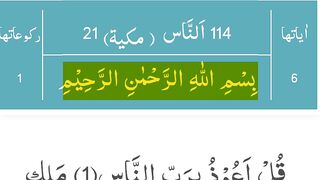
Surah an naas /read beauti sound
Surah An-Naas (Arabic: سورة الناس) is the 114th and final chapter of the Quran. It is a short chapter consisting of six verses. Here is a summary of its key points:
1. **Theme...

Al Quran reading The Quran is the holy book of , believed to be the literal word of God (Allah) as revealed to the Prophet Muhammad (peace be upon him) over a period of approximately 23 years. It is written in Arabic and is considered the ultimate source of guidance for Muslims in all aspects of life. Here is an overview of the Quran: 1. **Revelation and Compilation**: - The Quran was revealed to Prophet Muhammad by the angel Gabriel (Jibril) starting in 610 CE and continued until the Prophet's death in 632 CE. - The revelations were initially memorized and written down by the Prophet's companions. After his death, these revelations were compiled into a single book during the caliphate of Abu Bakr and finalized during the caliphate of Uthman ibn Affan. 2. **Structure**: - The Quran consists of 114 chapters, known as surahs, which vary in length. Each surah is made up of verses called ayahs. - The chapters are not arranged in chronological order of revelation but rather primarily by length, with the longer surahs at the beginning and shorter ones towards the end. 3. **Themes and Content**: - **Theology**: The Quran emphasizes the oneness of God (Tawhid), His attributes, and His creation. - **Guidance**: It provides guidance on personal conduct, social justice, law, family life, and moral values. - **Stories of Prophets**: It recounts the stories of various prophets, such as Adam, Noah, Abraham, Moses, and Jesus, highlighting their struggles and the messages they brought. - **Eschatology**: It describes the Day of Judgment, the afterlife, and the fate of the righteous and the wicked. - **Laws and Ethics**: The Quran contains legal rulings and ethical guidelines that govern aspects of life such as marriage, inheritance, fasting, charity, and justice. 4. **Language and Style**: - The Quran is known for its unparalleled linguistic beauty and eloquence in Arabic. Its style is poetic and rhythmic, which makes it easy to memorize and recite. - It employs various literary devices, including metaphors, similes, parables, and allegories. 5. **Recitation and Memorization**: - Reciting the Quran (Tilawah) is a central act of worship in . It is often recited in daily prayers and during special occasions like Ramadan. - Memorization of the Quran (Hifz) is highly encouraged, and those who memorize the entire Quran are given the honorary title of Hafiz. 6. **Translations and Exegesis**: - The Quran has been translated into many languages to make its message accessible to non-Arabic speakers. However, translations are considered interpretations of the meanings, not the exact word of God. - Exegesis (Tafsir) is the scholarly interpretation and explanation of the Quran. It provides context, commentary, and detailed analysis of the verses. 7. **Significance**: - The Quran is considered the ultimate source of guidance, law, and spirituality for Muslims. - It plays a central role in education, culture, and civilization. - Muslims believe that the Quran is a timeless miracle and a living text, offering guidance for all aspects of life and all times. In summary, the Quran is the cornerstone of faith and practice, embodying the spiritual, ethical, and legal framework that guides the lives of over a billion Muslims around the world.