
A Comet Stopped Spinning — Then Began Rotating Backward
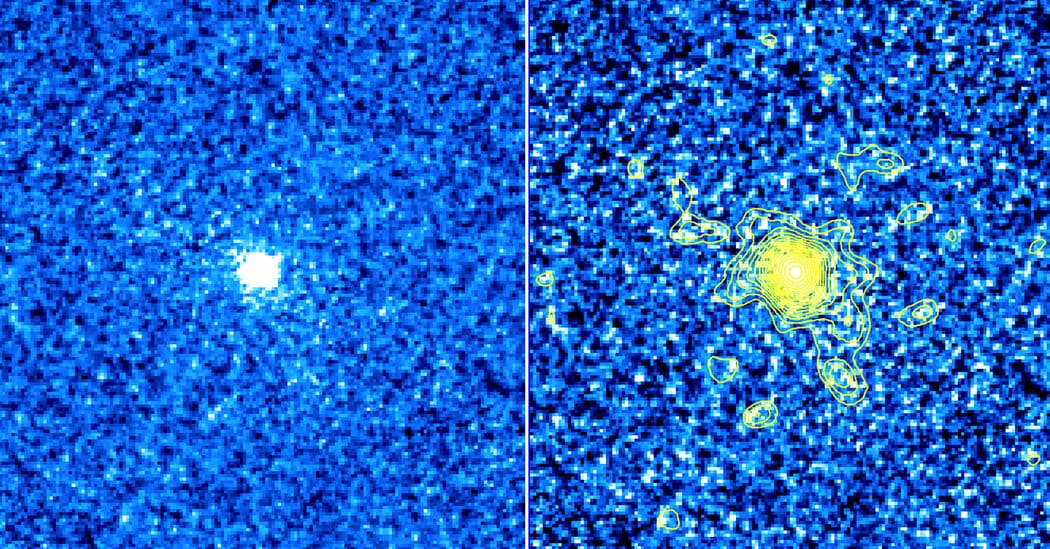
If you had been standing on Comet 41P/Tuttle-Giacobini-Kresák as it moved toward the sun in 2017, the length of a day would have shortened dramatically over weeks, the rotation would have stopped, and then the nucleus would have begun turning the other way. David Jewitt of the University of California, Los Angeles, examined Hubble Space Telescope images from that year to study the reversing spin.
Comets spin like planets and asteroids, and astronomers had already seen 41P’s rotation slow substantially before Hubble revealed it was turning the opposite direction. "We’ve seen changes in spin," Dr. Jewitt said, "but not this big and so quick." Jets of gas and dust blasting from a comet’s surface can act like a rocket; as Dennis Bodewits of Auburn University put it, "We don’t really understand that," but the force of such jets can be enough to change a comet’s spin.
Observers using NASA’s Swift telescope tracked 41P as it neared the sun in 2017.
United States, Los Angeles
comet 41p, rotation, spin reversal, hubble telescope, nasa swift, david jewitt, dennis bodewits, jets, nucleus, 2017