
Hubble captures young stellar objects in NGC 1333
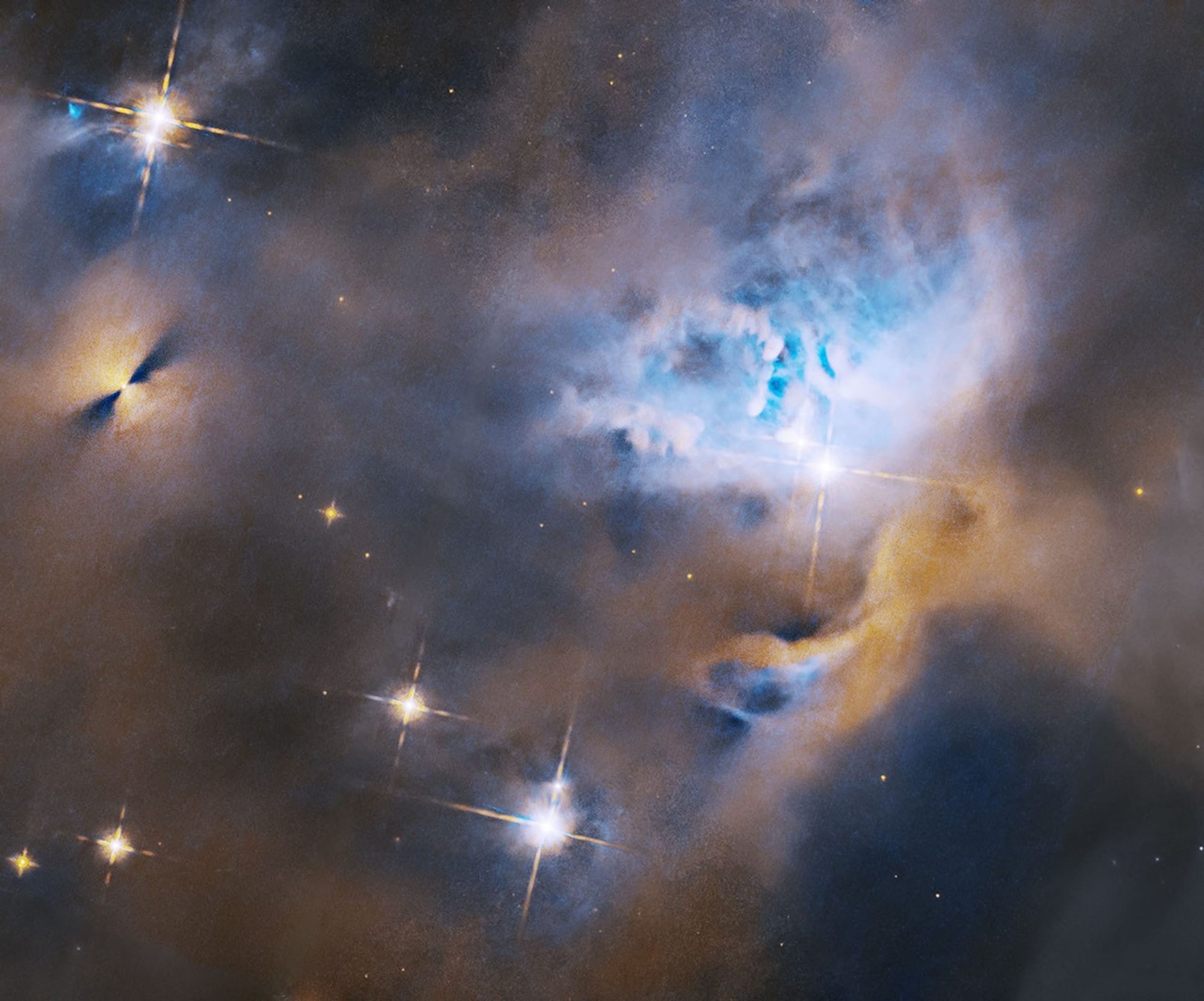
NASA’s Hubble Space Telescope has released a new image of the star-forming region NGC 1333 that shows a diverse collection of young stellar objects, including a protostar with a protoplanetary disk and several Orion variable stars. To the left of the image an actively forming protostar lights a surrounding reflection nebula.
Two dark stripes on opposite sides of the bright point (upper left) are identified as the protoplanetary disk and the disk’s shadow cast across the large envelope of material around the star. Material accumulates onto the protostar through this rotating disk of gas and dust, a product of the collapsing cloud that gave birth to the star.
To the center right, an outflow cavity opens into a fan-shaped reflection nebula. The two stars at its base, HBC 340 (lower) and HBC 341 (upper), unleash stellar winds that clear the cavity from the surrounding molecular cloud over time. The reflection nebula fluctuates in brightness, which researchers attribute to variations in brightness of HBC 340 and HBC 341, with HBC 340 described as the brighter and more variable source.
HBC 340, HBC 341 and several other bright points in the image are identified as Orion variable stars, a class of forming stars that change brightness irregularly and may do so because of stellar flares and ejections of matter.
Key Topics
Science, Perseus Molecular Cloud, Hubble Space Telescope, Protoplanetary Disk