
Hubble images show protostars and jets carving cavities in Orion cloud
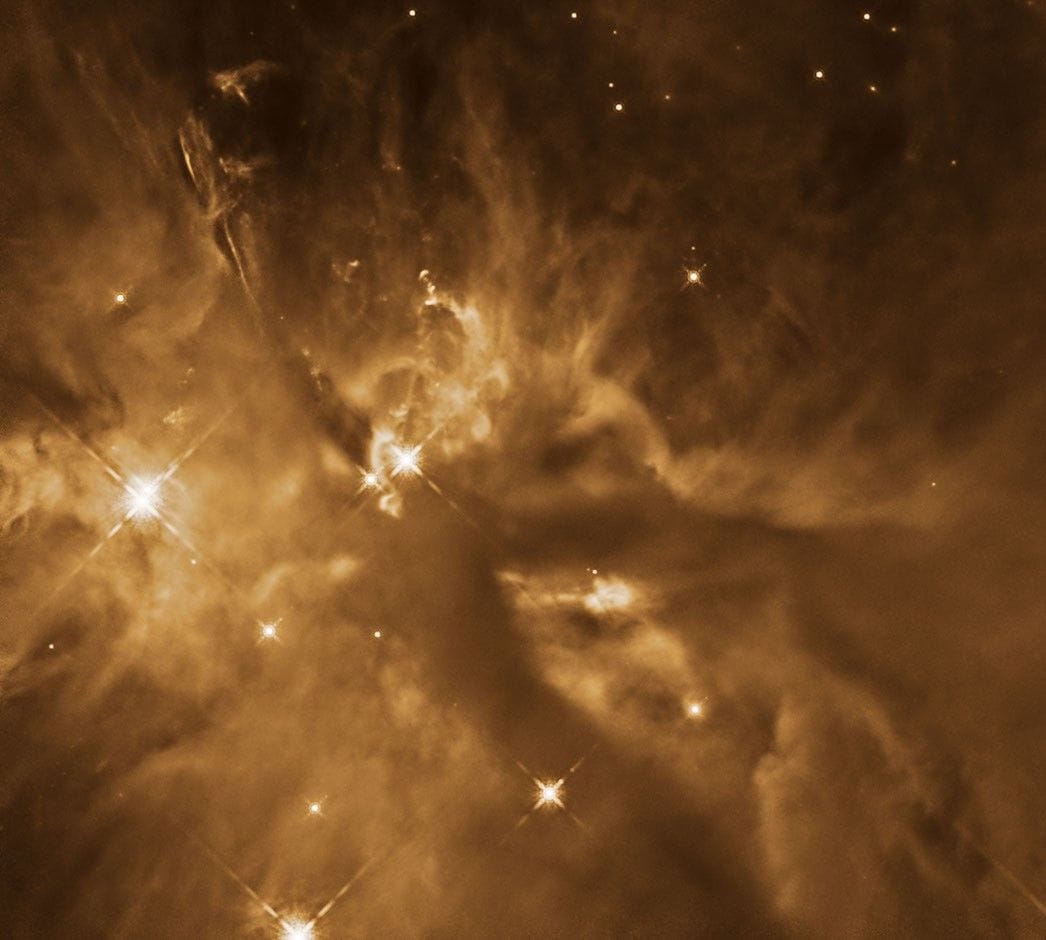
NASA’s Hubble Space Telescope has captured three images of just-forming stars, or protostars, in the Orion Molecular Cloud complex, a region in the “sword” of the constellation Orion roughly 1,300 light‑years away. The images were taken as part of an effort to study the envelopes of gas and dust around protostars and the outflow cavities where stellar winds and jets carve away surrounding material.
Scientists used these Hubble observations as part of a broader survey of protostellar envelopes. Researchers found no evidence that outflow cavities were growing as protostars moved through later stages of formation, and they reported that decreasing accretion of mass onto protostars over time and the low rate of star formation in the cool molecular clouds cannot be explained by progressive clearing of the envelopes.
The images show several specific features: HOPS 181 lies concealed behind dusty clouds near the image center, with a long curved arc in the top left shaped by outflow from the protostar; CVSO 188 appears as a bright star in the lower right quadrant; HOPS 310, hidden just left of center, is credited with carving a large cavity with bright walls and a bipolar jet running diagonally to the top right.
Light from nearby stars reflecting off dust grains gives the region a soft glow, and some background galaxies and stars are visible. These observations feed into the broader survey of young stellar objects.
Key Topics
Science, Orion Molecular Cloud, Hubble Space Telescope, Protostars, Protostellar Envelopes