
Hubble unveils images of protoplanetary disks and protostars
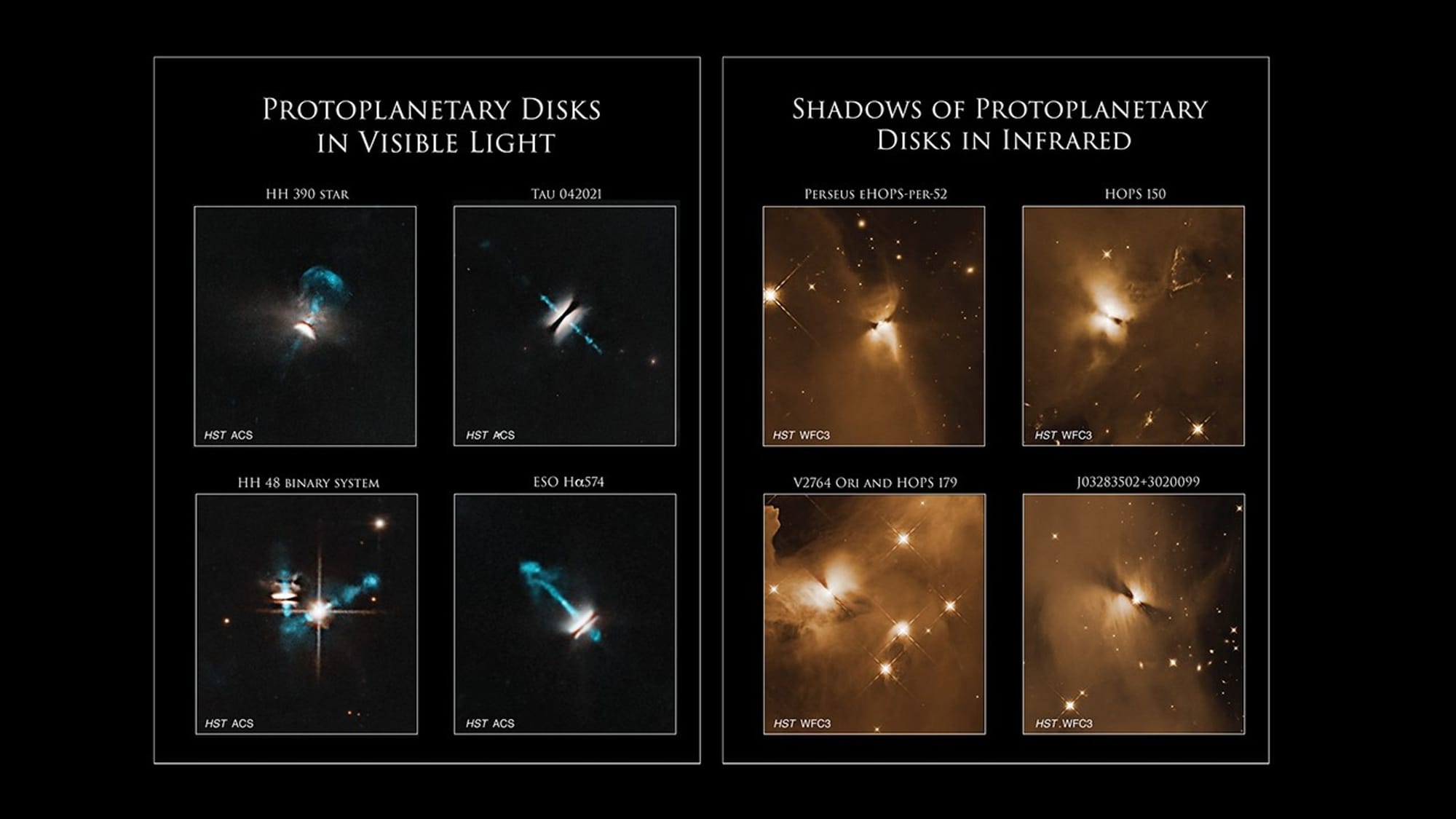
NASA’s Hubble Space Telescope released a collection of new visible- and infrared-light images showing protoplanetary disks, the swirling gas-and-dust structures that surround forming stars. Visible-light frames show dark, planet-forming dust disks around hidden protostars with bipolar jets of gas traveling about 93 miles (150 km) per second.
The visible images include protostars about 450 light-years away in the Taurus Molecular Cloud and nearly 500 light-years away in the Chameleon I region; separate infrared edge-on views show objects in the Orion Molecular Cloud complex (about 1,300 light-years) and the Perseus Molecular Cloud (roughly 1,500 light-years).
Hubble’s images illustrate stages of star formation: collapsing clouds of gas and dust feed rotating disks that supply material to protostars while remaining material can form planets. Bright yellow regions in the images are reflection nebulae lit by the stars, and jets launched from protostellar magnetic poles help disperse angular momentum so material can collect.
Some jets appear to broaden where fast gas collides with surrounding material, producing shock emission. The infrared views reveal thick, dusty disks and wide dark areas that are often shadows cast by central disks; the bright haze in those images comes from starlight scattering off dust.
Key Topics
Science, Protoplanetary Disks, Protostars, Hubble Space Telescope, Taurus Molecular Cloud, Chameleon I