
Faded hand stencil in Sulawesi cave dated to at least 67,800 years
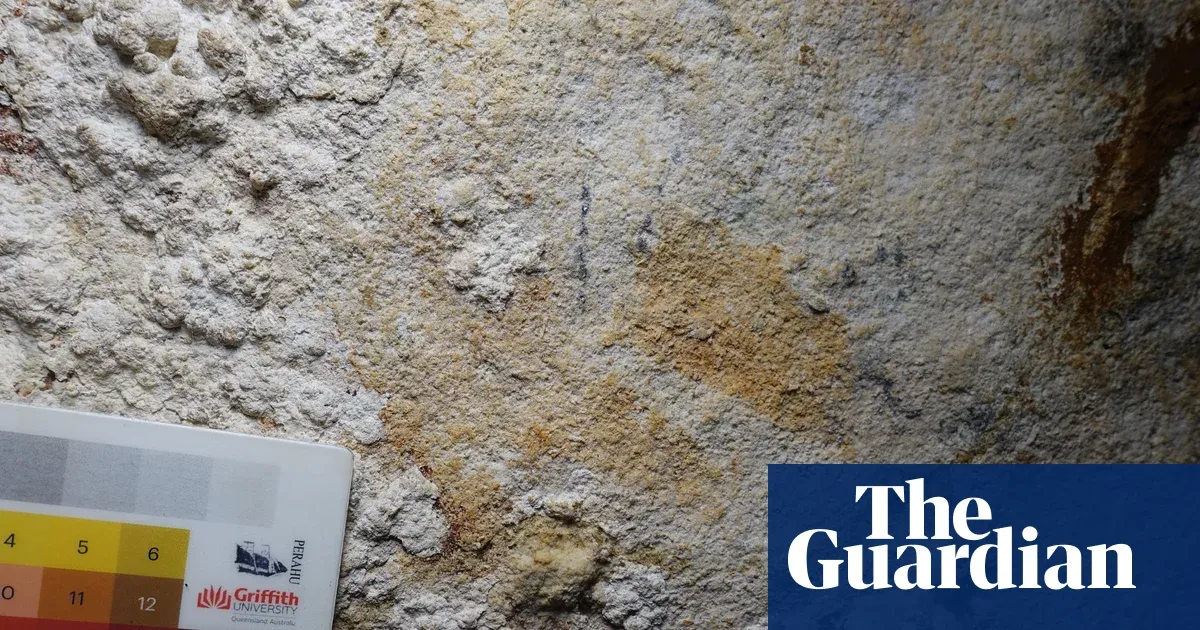
Archaeologists say the faded outline of a hand on a cave wall in Indonesia may be the world’s oldest known rock art, and that it was created at least 67,800 years ago. The stencil was found in a limestone cave on Muna Island in south-eastern Sulawesi. The hand outline was discovered at Liang Metanduno cave, where it had gone unnoticed among more recent paintings of animals and other figures.
The team ascribed a minimum age by dating tiny calcite deposits that had formed over the top. Fieldwork to date the cave art was led by researchers from Griffith University, including Prof Maxime Aubert and Prof Adam Brumm, and the authors say humans have painted in the cave for millennia, with fresh images for at least 35,000 years.
The stencils were made by spraying mouthfuls of ochre mixed with water over a hand pressed to the wall. The Liang Metanduno example has narrow, pointy fingers that the researchers believe were an intentional modification. Brumm said: “Whether they resemble animal claws or more fancifully some human-animal creature that doesn’t exist, we don’t know, but there’s some sort of symbolic meaning behind them.” Writing in Nature, the authors argue the tweaks make the rock art "complex" and so probably the work of Homo sapiens, but they add other long-gone human species cannot be ruled out.
Key Topics
Science, Liang Metanduno, Muna Island, Sulawesi, Griffith University, Maxime Aubert