
SunRISE SmallSats pass launch vibration tests, move closer to launch
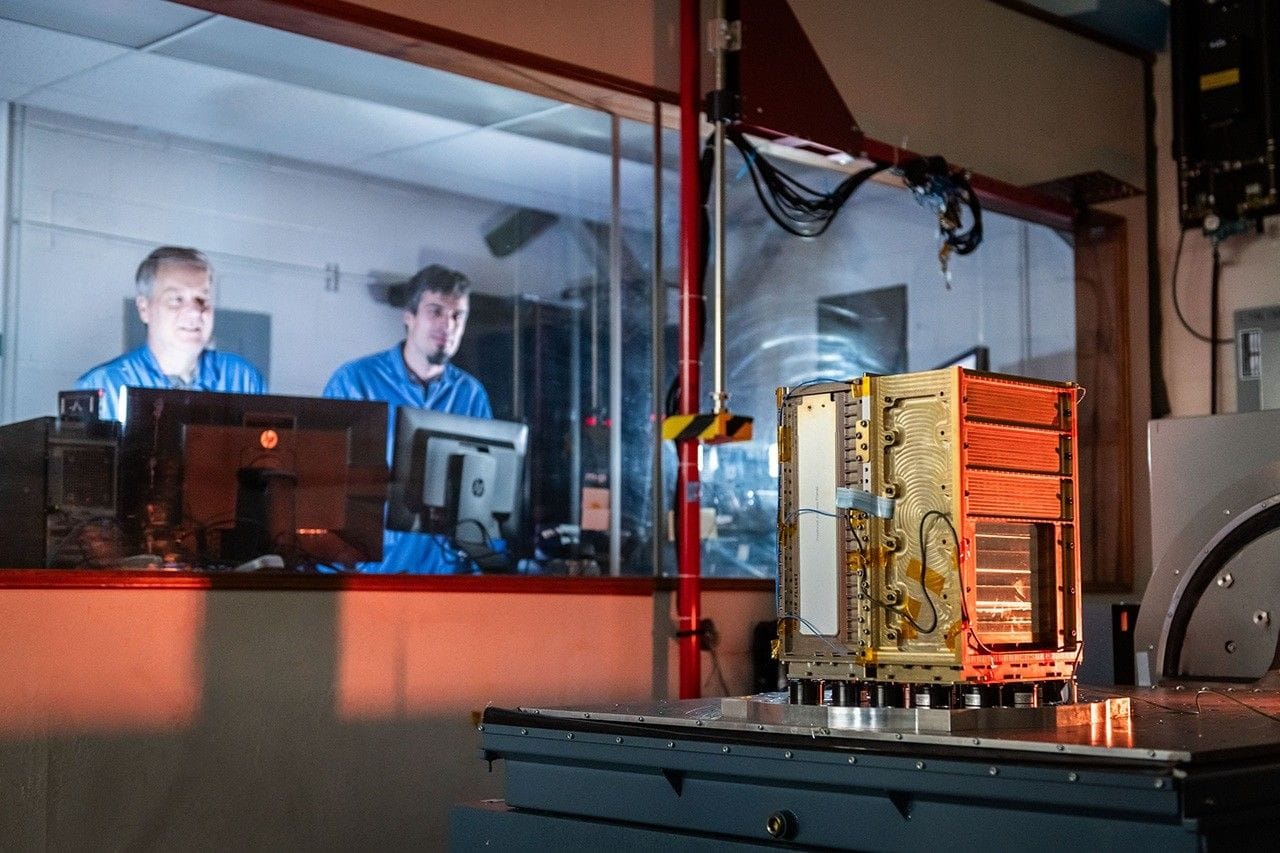
Six SunRISE SmallSats built at Utah State University’s Space Dynamics Laboratory in Logan, Utah, have passed a series of environmental and vibration tests, moving the mission closer to its planned launch later this year. The testing campaign included thermal vacuum testing to simulate orbit conditions, electromagnetic compatibility checks to ensure electronics won’t interfere with instruments, and a final vibration test that simulated the intense vibrations of the mission’s specific ride into space.
"Each spacecraft was loaded with propellant to match launch mass and subjected to vibration testing in all three axes. The objective was to make the simulated vibrations as true to the conditions of launch as possible," said Jim Lux, SunRISE project manager at NASA’s Jet Propulsion Laboratory.
Pre- and post-test functional checks were performed, and all six spacecraft aced them. SunRISE will operate six toaster-oven-size spacecraft as a distributed radio telescope to track solar radio bursts produced by solar energetic particle events. The SmallSats are scheduled to launch as a rideshare from Cape Canaveral Space Force Station aboard a United Launch Alliance Vulcan Centaur rocket, sponsored by the United States Space Force’s Space Systems Command.
Key Topics
Science, Sunrise, Smallsats, Space Dynamics Laboratory, Vulcan Centaur, Cape Canaveral