
Webb captures detailed structures and chemistry in the Helix Nebula
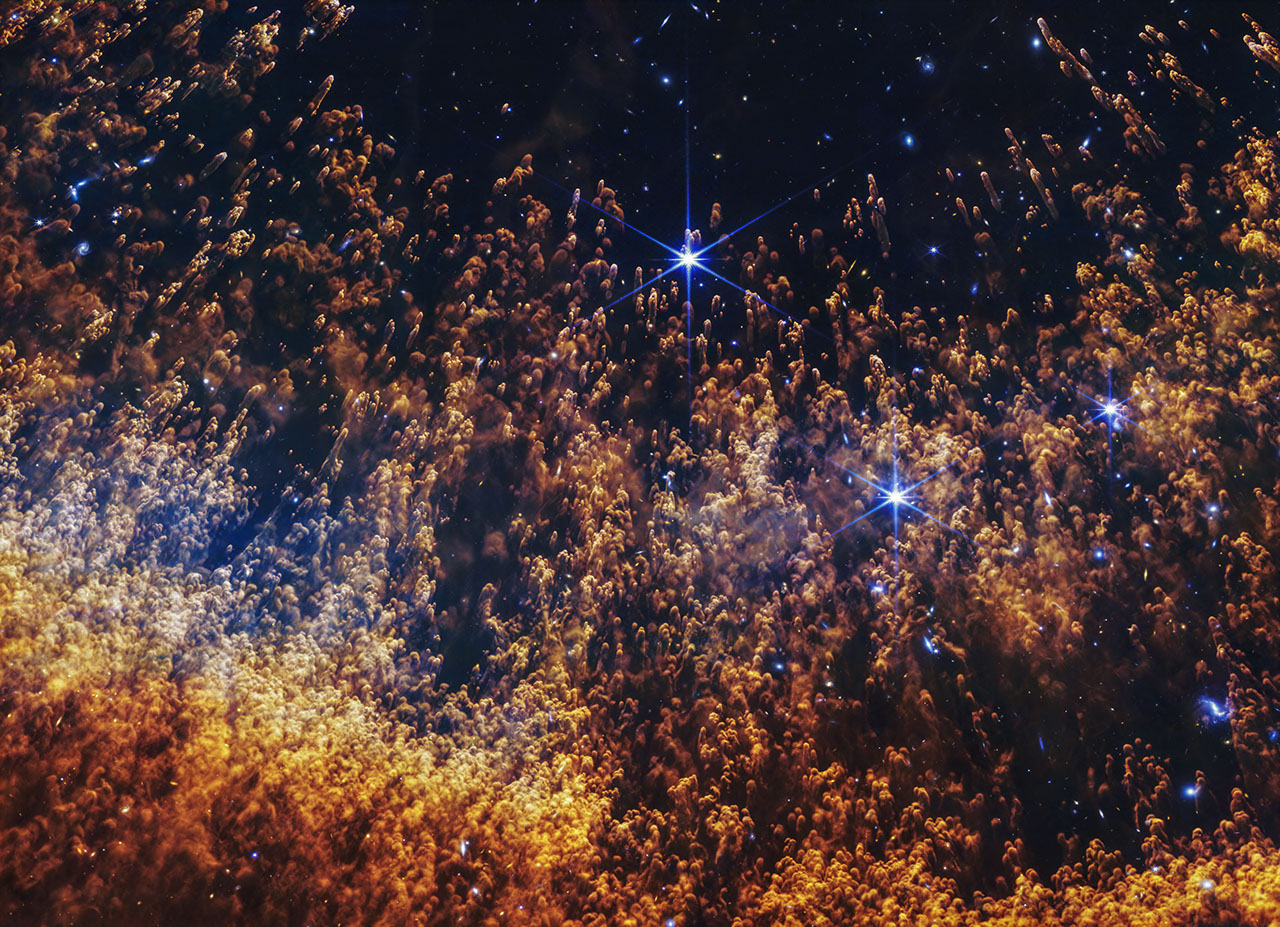
NASA’s James Webb Space Telescope has produced a high-resolution near-infrared image of a portion of the Helix Nebula that highlights comet-like knots, fierce stellar winds and layers of gas being shed by a dying star. Webb’s NIRCam image shows pillar-like features with extended tails tracing the inner edge of an expanding gas shell, where fast, hot winds from the dying star collide with earlier, slower shells of colder dust and gas and sculpt the nebula.
The image reveals a clear transition from the hottest gas nearest the central white dwarf to progressively cooler molecular hydrogen and then the coolest regions where dust can form; Webb’s resolution brings the knots to the forefront compared with Hubble and sharpens detail beyond Spitzer’s snapshot.
The blazing white dwarf that powers the nebula lies at its heart but is outside Webb’s frame; its intense radiation produces hot ionized gas (seen with a blue hue in the image), cooler yellow regions where hydrogen molecules form, and reddish outer edges where gas thins and dust can take shape.
Spitzer’s earlier studies hinted at complex molecules forming here, and Webb’s view shows those molecules forming in shielded pockets visible as dark regions amid the glowing orange and red.
Key Topics
Science, Webb Telescope, Helix Nebula, Nircam, White Dwarf, Molecular Hydrogen