
Webb confirms galaxy MoM-z14 280 million years after Big Bang
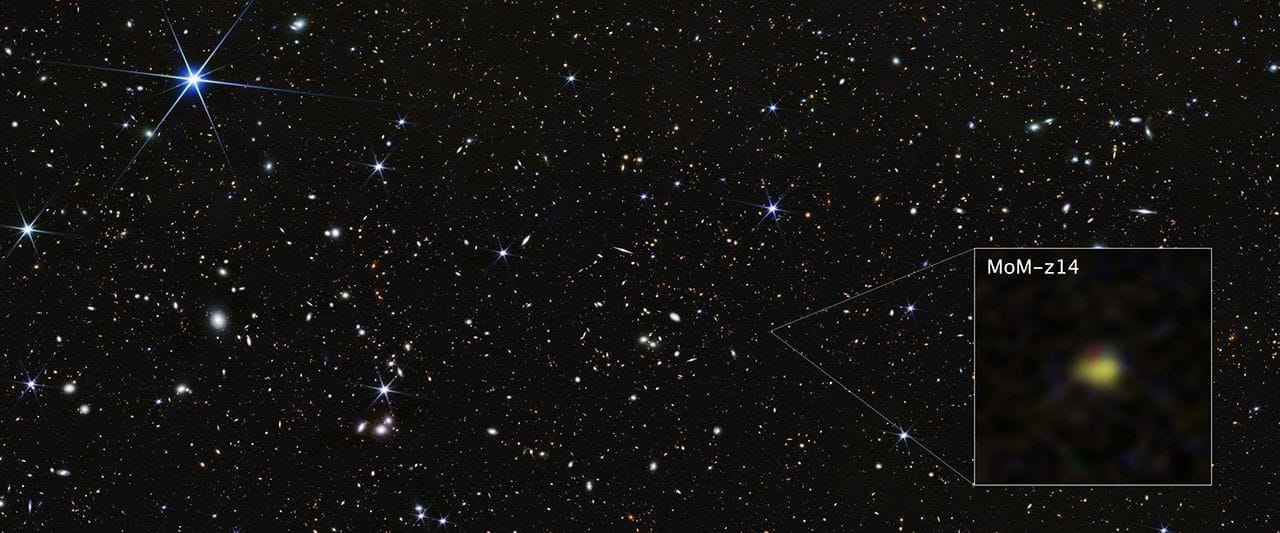
NASA’s James Webb Space Telescope has confirmed a bright galaxy named MoM-z14 as it appeared about 280 million years after the big bang, measuring a cosmological redshift of 14.44 with Webb’s NIRSpec instrument. The result is described in a paper led by Rohan Naidu of MIT published in the Open Journal of Astrophysics.
The team says the measured redshift means the galaxy’s light has been stretched to longer, redder wavelengths as space expanded and has been travelling for about 13.5 of the universe’s estimated 13.8 billion years. "We can estimate the distance of galaxies from images, but it’s really important to follow up and confirm with more detailed spectroscopy so that we know exactly what we are seeing, and when," said Pascal Oesch of the University of Geneva, co-principal investigator of the survey.
MoM-z14 is one of a growing group of surprisingly bright early galaxies — the research team says these objects are about 100 times more numerous than theoretical studies predicted before Webb’s launch. "There is a growing chasm between theory and observation related to the early universe, which presents compelling questions to be explored going forward," said Jacob Shen, a postdoctoral researcher at MIT and a member of the research team.
The observations also show unusual nitrogen enrichment in MoM-z14, a feature seen in a small percentage of the oldest Milky Way stars.
mom-z14 galaxy, redshift 14.44, 280 million years after big bang, james webb space telescope, webb nirspec spectroscopy, rohan naidu mit, pascal oesch university of geneva, jacob shen mit, yijia li pennsylvania state, open journal of astrophysics paper, nitrogen enrichment mom-z14, early universe galaxies, surprisingly bright galaxies, cosmic reionization timeline, primordial hydrogen fog, supermassive early stars, milky way ancient stars, gn-z11 galaxy, hubble space telescope, nancy grace roman space telescope, dark energy expansion, cosmological redshift measurement, kavli institute mit