
Webb produces highest-resolution dark matter map of COSMOS region
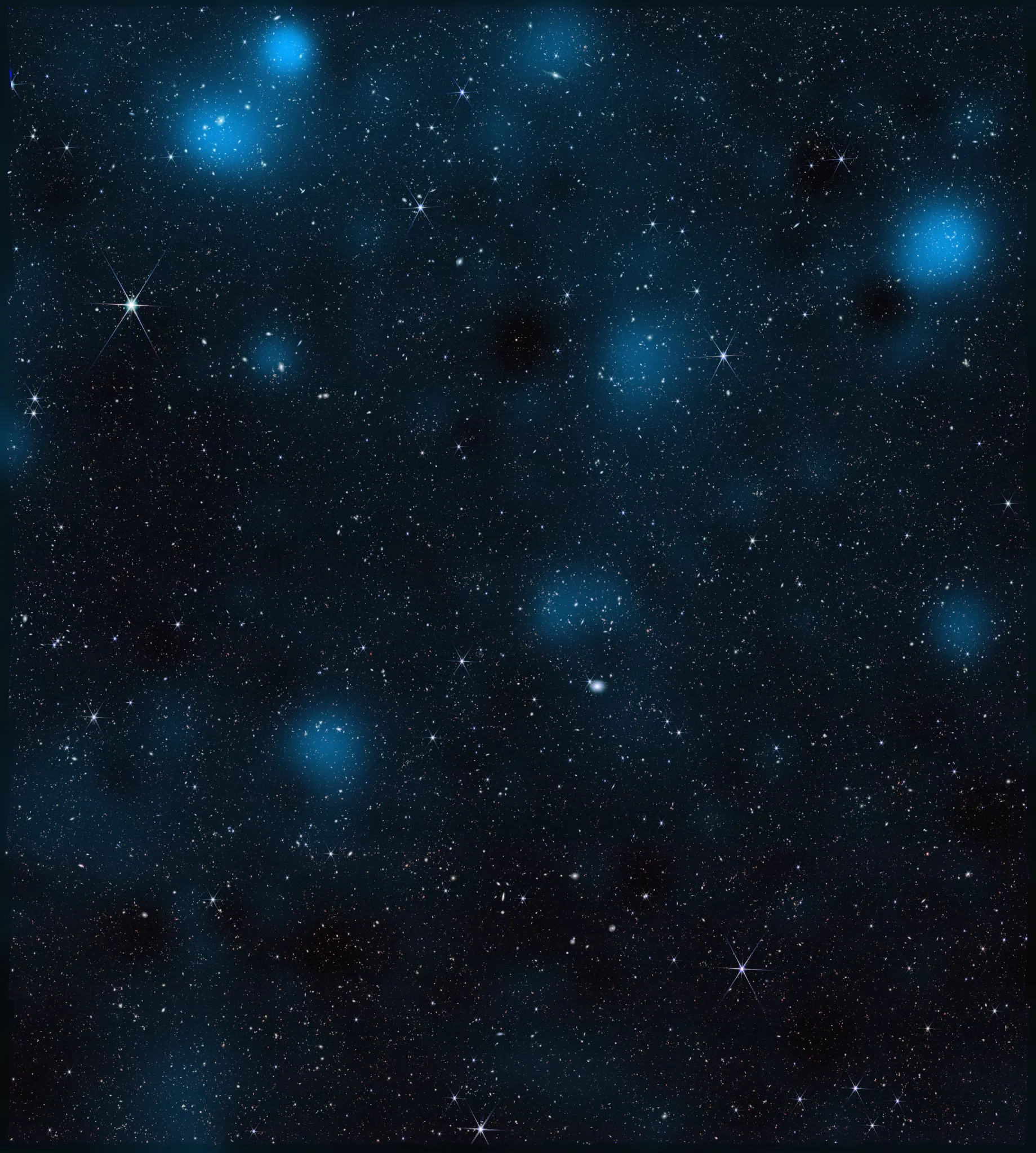
Scientists using data from NASA’s James Webb Space Telescope have produced one of the most detailed, high-resolution maps of dark matter ever made, covering a section of the COSMOS field in the constellation Sextans. Published Monday, Jan. 26, in Nature Astronomy, the map shows how invisible dark matter overlaps and intertwines with regular matter and builds on previous research to confirm and add details about how dark matter has shaped galaxy clusters millions of light-years across — structures that give rise to galaxies, stars and planets like Earth.
"This is the largest dark matter map we’ve made with Webb, and it’s twice as sharp as any dark matter map made by other observatories," said Diana Scognamiglio, lead author and an astrophysicist at NASA’s Jet Propulsion Laboratory. Webb peered at the region for about 255 hours and identified nearly 800,000 galaxies.
The team mapped dark matter by measuring how its mass curves space and bends light, and the Webb map contains about 10 times more galaxies than ground-based maps and twice as many as Hubble’s, revealing new clumps and higher-resolution structure. To refine distances the researchers used Webb’s Mid-Infrared Instrument (MIRI) alongside other telescopes, and the project builds on a 2007 Hubble map led by Richard Massey and Jason Rhodes.
The authors say the close alignment of dark and regular matter seen in the map is evidence of dark matter’s gravity pulling ordinary matter together over cosmic history.
Key Topics
Science, Dark Matter, Cosmos Survey, Sextans, Webb Telescope, Diana Scognamiglio