
Webb data used to map dark matter across a 0.54 sq. degree field in Sextans
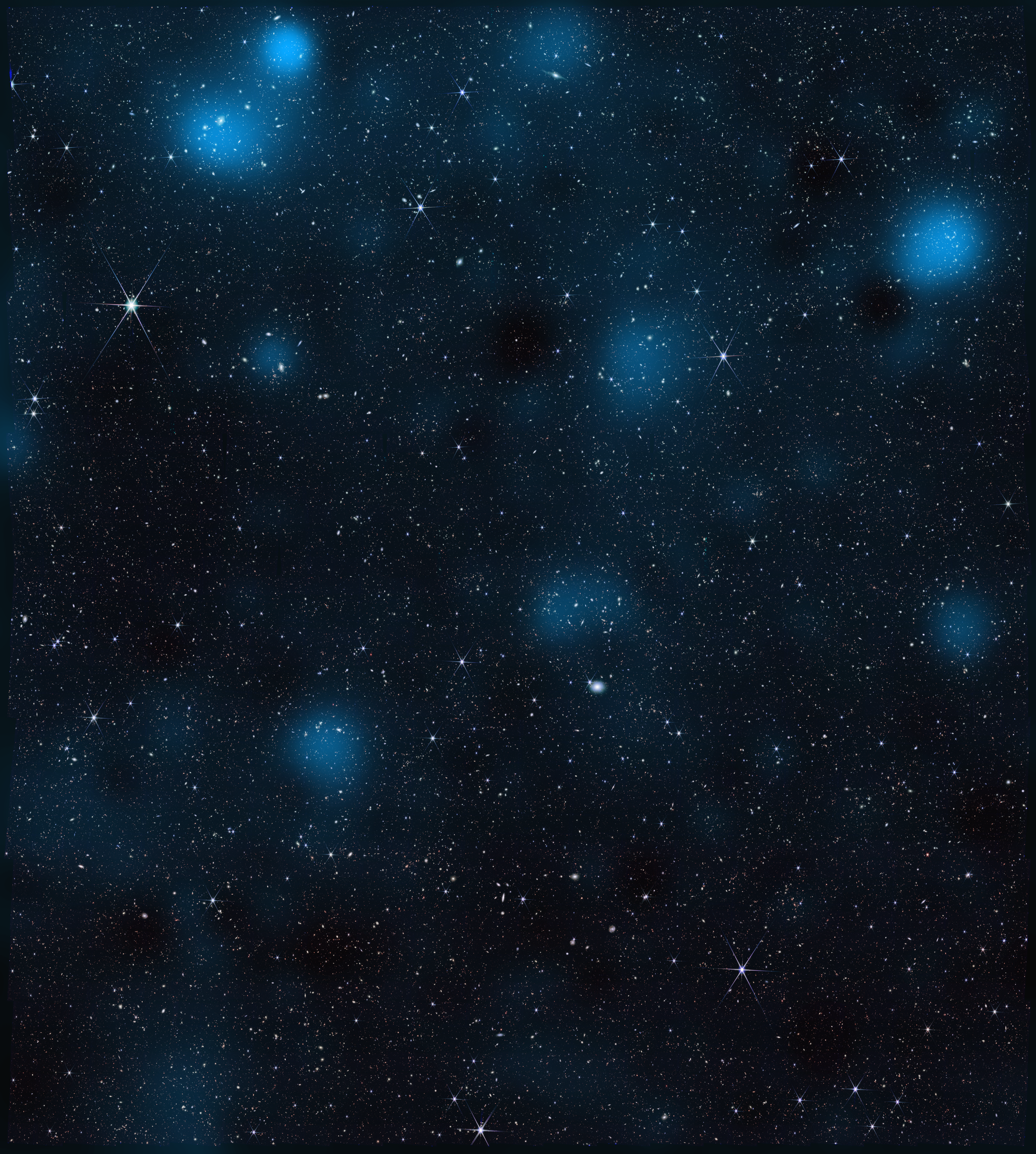
NASA’s James Webb Space Telescope observed a 0.54 square degree region in the constellation Sextans and, using those data, researchers produced a dark matter map overlaid on an image containing nearly 800,000 galaxies. The map shows dark matter in blue, with brighter blue indicating higher dark matter density.
Webb’s Near-Infrared Camera (NIRCam) spent about 255 hours peering at the field. Because dark matter does not emit, reflect, absorb or block light, the team inferred its distribution from its gravitational effects on ordinary matter: large concentrations curve spacetime and distort light from background galaxies.
The map was created using weak gravitational lensing, which measures the subtle distortions of thousands of galaxy images. The Webb dark matter map contains roughly ten times more galaxies than maps of the area made by ground-based observatories and about twice as many as a 2007 Hubble Space Telescope map, revealing new clumps and providing higher resolution.
Both the Hubble and Webb maps are part of the COSMOS project, whose full field spans 2 square degrees and has been imaged by at least 15 telescopes. To refine galaxy distance measurements for the map, the team used Webb’s Mid-Infrared Instrument (MIRI) along with other space- and ground-based telescopes; MIRI is also well suited to detect galaxies obscured by cosmic dust.