
Webb finds no thick atmospheres on TRAPPIST-1 b and c; studies continue
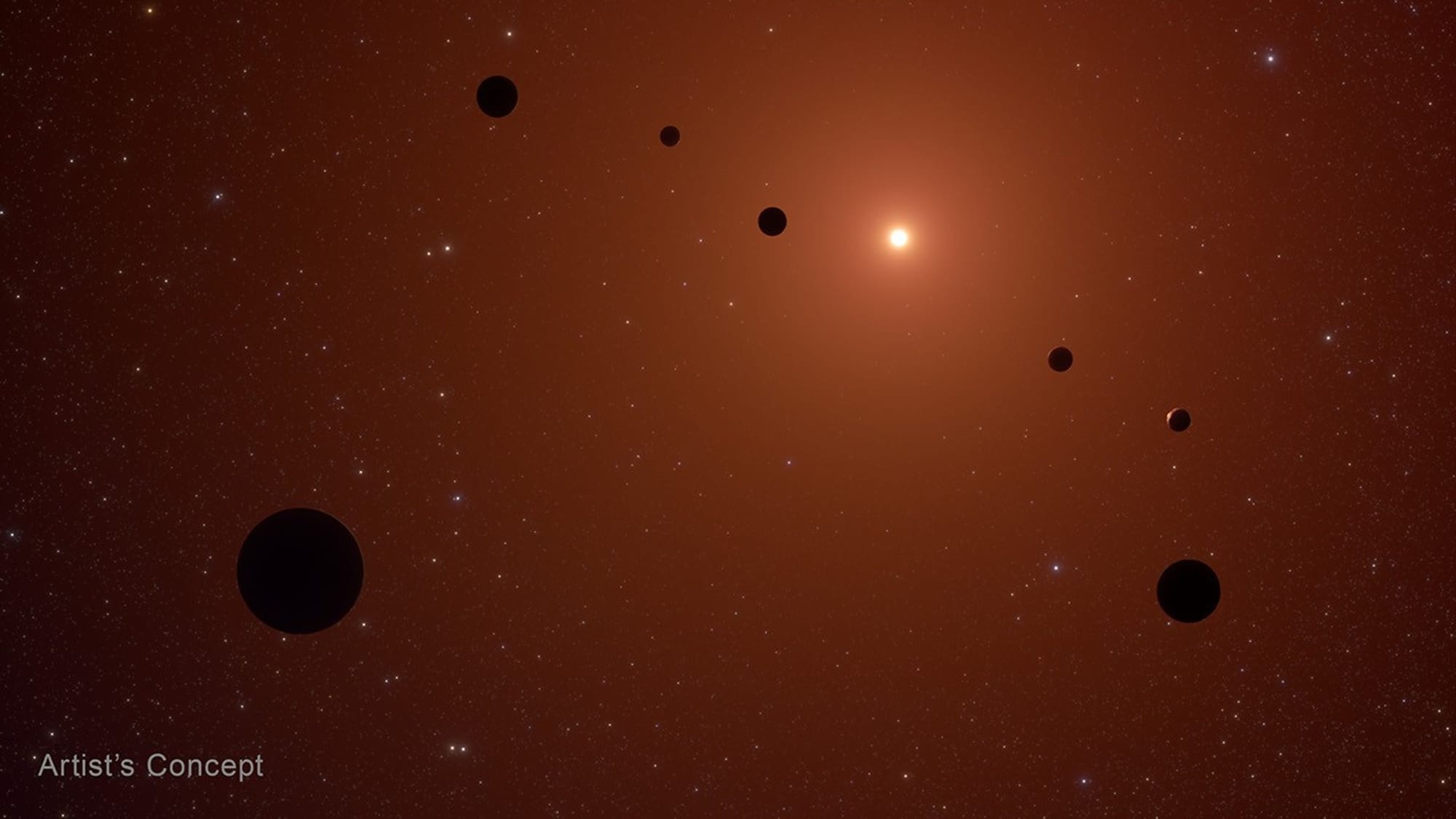
NASA’s James Webb Space Telescope is deepening study of the TRAPPIST-1 system, a collection of at least seven Earth-sized rocky planets orbiting a red dwarf about 40 light-years away. Follow-up work after the initial 2015 ground-based detections established the system’s seven roughly Earth-sized worlds, with Spitzer measurements used to determine their sizes, masses and likely rocky densities.
Spitzer data also indicated that planets e, f and g lie in the star’s habitable zone, and Hubble observations ruled out puffy, hydrogen-rich atmospheres for some planets. Webb, operating from L2 with infrared sensitivity and a larger mirror, can lock onto the system continuously and collect the wavelengths and precision needed to probe exoplanet atmospheres using transits, secondary eclipses and phase curves.
Data has been collected for all seven planets, and as of December 2025 the science community has reported Webb observations for planets b, c, d and e. So far Webb has not seen signs of thick atmospheres on TRAPPIST-1 b and TRAPPIST-1 c; current data suggest b may be a bare rock, and if c has an atmosphere it is likely very thin.
For d and e the data are still under study, though thick hydrogen atmospheres have been ruled out for those two as well. Analyses are complicated by the host star’s stronger-than-expected activity: flares and star spots can contaminate atmospheric signals, so astronomers expect to collect many more observations than anticipated.
Key Topics
Science, Spitzer Space Telescope, Hubble Space Telescope, Red Dwarf Star, Habitable Zone