
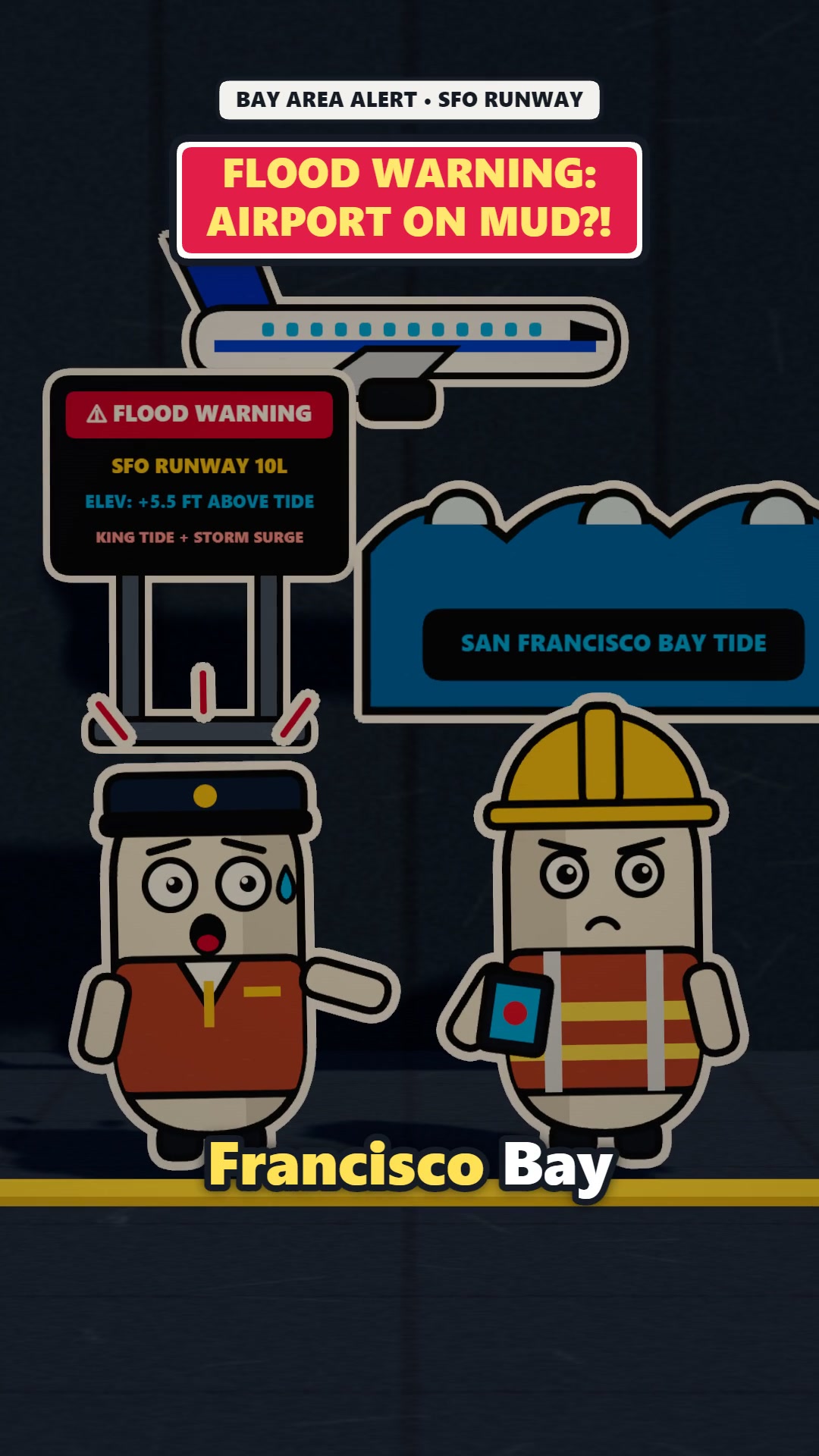
Flood Warning Bay Area: Why SFO Airport Was Built on Sinking Mud
As a Bay Area flood warning and king tides threaten the coast, discover why San Francisco International Airport (SFO) sits on sinking bay mud and stays dry.
As a Bay Area flood warning and king tides threaten the coast, discover why San Francisco International Airport (SFO) sits on sinking bay mud and stays dry.
Whenever an extreme coastal flood warning hits the San Francisco Bay Area, San Francisco International Airport (SFO) becomes one of the most heavily defended pieces of infrastructure in North America. Unlike inland airports built on solid bedrock, SFO began in 1927 as Mills Field on low-lying tidal marsh and soft mudflats along the San Francisco Bay.
To expand the airfield for modern commercial aviation, engineers reclaimed land from the bay by dumping millions of tons of artificial fill directly on top of soft, compressible Young Bay Mud. Because this underlying mud layer behaves like a dense wet sponge under heavy loads, sections of the airfield experience ongoing soil consolidation and slow settlement over time.
Key Engineering & Geography Facts:
• Foundation Geology: Reclaimed tidelands laid over compressible San Francisco Young Bay Mud since 1927.
• Shoreline Exposure: Flanked by 8 miles of open San Francisco Bay shoreline, with Runway 10L sitting just 5.5 feet above standard high water datums.
• Flood Defense System: Protected by an 8-mile perimeter of earthen berms, concrete-capped steel sheet-pile seawalls (upgraded up to 13 feet under SFO's Shoreline Protection Program without violating FAA runway approach clearances), and high-capacity industrial storm drainage pumps.
Frequently Asked Questions (FAQ):
Q: Why is San Francisco International Airport vulnerable during a Bay Area flood warning?
A: SFO juts out into the San Francisco Bay on reclaimed mudflats with 8 miles of shoreline, making it highly exposed when seasonal King Tides combine with El Niño storm surges and heavy rainfall.
Q: How does SFO prevent its runways from flooding?
A: SFO uses an 8-mile perimeter of steel sheet-pile seawalls, perimeter dikes, and industrial storm pumps that continuously discharge runoff back into the bay while keeping runway approach zones free of tall obstacles.
#floodwarning #bayareafloodwarning #sanfranciscoairportflood #sfoairport #kingtidesbayarea #whysfowasbuiltonmud #sanfranciscobaymudflats #shorelineprotectionprogram #airportengineeringexplained #coastalflooddefense #howseawallswork
Sign in to join the conversation.
 Sign in with Google
Comments